What should a small business do first for GEO?
Start with one service page: answer the buyer's main question, state the scope of the offer, place verifiable evidence beside important claims, and link to the page from a relevant guide. This is our practical starting point, not a promise of AI inclusion.
Use the implementation checklist · Measure the changes · Check the sources
A page-level GEO checklist
- Choose one buyer question. Write a direct answer before introducing background. Include important limits, such as service area or what the offer excludes.
- Attach evidence to claims. Link to the original source. Give its date and scope where those change the meaning. Label your own examples and estimates.
- Make facts consistent. Check the business name, author, service details, and contact route across the page and its structured data.
- Connect the reading path. Link the guide to the relevant service and the service back to useful evidence. Use link text that names the destination.
- Verify access and eligibility. Check page status, robots directives, canonical URL, mobile rendering, and indexing evidence before adding more content.
Google does not require an AI-specific text file or dedicated schema for AI Overviews or AI Mode. Important information should be available as text, and structured data should match visible content. Google: AI features and your website.
How to check whether an edit helped
Before changing a page, save its URL and a short list of buyer questions. For each observation, record the exact question, date, platform, model or mode when shown, and locale. Keep the answer and cited URLs. Repeat the same questions after the change, recording changes in test conditions.
Report a citation sample as a count with its denominator, such as “cited in 2 of 10 recorded answers.” This is an illustration, not an Opslumo result. Do not call the sample market share or assume all users see the same answers. Review referral visits and qualified inquiries separately; an absent referrer does not prove the visitor never used AI.
Google reports AI feature activity within overall Web search performance in Search Console. Treat that reporting boundary separately from your manual citation sample. Check the reporting guidance. For help applying this to your service pages, see our AI search audit scope.
Direct answer: the most defensible way to improve visibility in generative search is to publish crawlable, original, well-scoped answers supported by primary evidence. No formatting trick guarantees a citation. The goal is to reduce the work an AI system—or a buyer—must do to identify the claim, verify its source, understand its limits, and decide what to do next.
1. GEO is an evidence problem before it is a formatting problem
Conclusion: headings and concise answer blocks help retrieval, but they cannot substitute for a claim worth retrieving.
The original academic work that named generative engine optimization evaluated ways to improve source visibility in generated answers. Its authors reported that the effect varied by domain, which is an important limitation: there is no universal recipe that works for every question, engine, or market. Since then, “GEO” has often been reduced to tactics—add quotations, repeat entities, publish statistics, or write in a style that resembles an answer.
That is too shallow for a small business whose content must earn trust and leads. A page can be easy to parse and still be unhelpful. A statistic can be cited and still be out of date, mis-scoped, or disconnected from the service being offered. A generated answer can mention a brand without giving a buyer any reason to choose it.
The practical unit of GEO is therefore not the keyword. It is the verifiable claim: one conclusion, with a defined scope, an accessible source, a clear interpretation, and a decision it helps the reader make.
2. Google says AI-search optimization still begins with SEO fundamentals
Conclusion: a page cannot become a reliable AI-search source if it is difficult to crawl, index, or understand as a normal web page.
Google’s official guide for generative AI features says existing SEO best practices remain foundational. It specifically points website owners toward crawlability, index eligibility, technical clarity, helpful original content, good page experience, and accurate image and structured-data metadata. Google also states that meeting the requirements does not guarantee crawling, indexing, or appearance in a generated answer.
This creates a useful priority order. First, make the page technically available: a stable canonical URL, indexable HTML, descriptive title, visible main content, crawlable internal links, and a sitemap entry. Second, make the answer useful to the intended audience. Third, add metadata that accurately describes what is already on the page. Structured data is an explicit clue, not a replacement for the article.
For Opslumo clients, that means a GEO review should not begin by rewriting every paragraph into an “AI-friendly” voice. It should begin with the same questions as a technical SEO audit: Can the page be discovered? Is the primary content present in the rendered HTML? Does one URL own the topic? Are the author, date, image, and organization consistent? Does the page answer the search intent better than a thin service pitch?
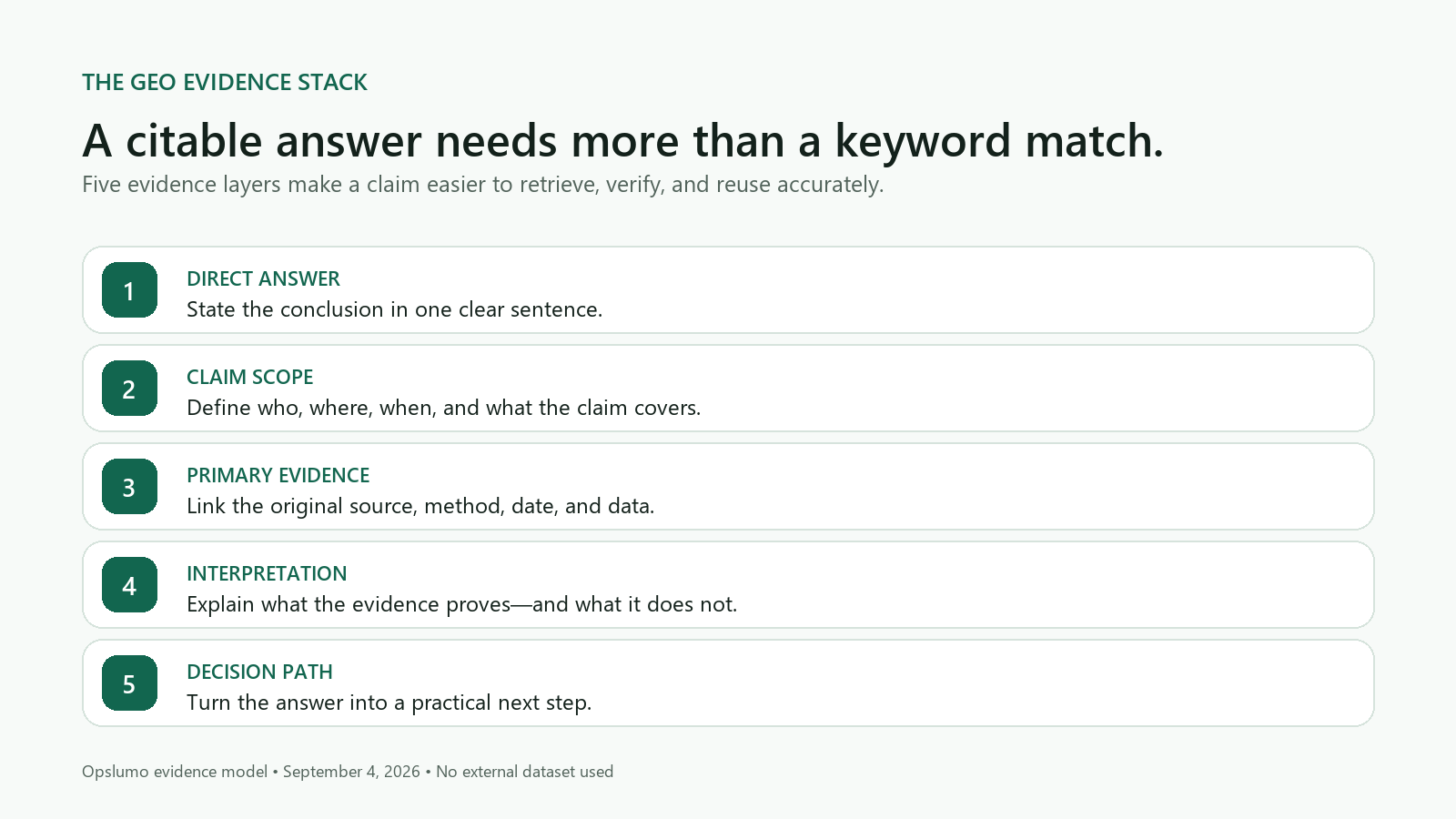
3. A citable claim needs five evidence layers
Conclusion: AI-readable content becomes more trustworthy when the reader can see the answer, its boundaries, its evidence, its interpretation, and its business implication in the same section.
- Direct answer. State the conclusion before the background. A reader should not need three introductory paragraphs to discover the position.
- Claim scope. Name the population, geography, time period, channel, or workflow the claim covers. “Automation improves productivity” is vague. “A read-only agent can draft a response without permission to send it” describes a testable boundary.
- Primary evidence. Link the official guidance, original study, underlying dataset, or documented first-hand method. If only a secondary report is available, label it as secondary rather than presenting it as the original source.
- Interpretation. Explain what the evidence supports and what it does not prove. This is where a business demonstrates judgment rather than simply repeating a number.
- Decision path. Give the reader a next action, trade-off, or diagnostic question. Evidence becomes commercially useful when it helps someone make a defensible decision.
This format is not an attempt to imitate an AI response. It is good explanatory writing. It also produces self-contained passages that can be quoted without losing their source or limitation.
4. More claims do not automatically create more GEO visibility
Conclusion: increasing the number of source-backed, decision-relevant claims can improve a page; increasing the number of unscoped assertions usually creates noise.
The useful question is not “How many arguments can we fit?” It is “How many distinct customer questions can this page answer accurately?” One substantial article may contain several citable answer blocks, but each block should earn its place. It needs a different conclusion, not a synonym of the previous paragraph.
For example, a workflow-automation service page might answer five separate questions: what should be automated first, which actions require approval, what data the workflow can access, how failures are logged, and how success is measured. Those are five arguments because they support five decisions. Repeating “automation saves time” under five headings is still one unsupported claim.
A practical editorial test is to extract every bold conclusion into a list. If two conclusions mean the same thing, combine them. If a conclusion has no source, method, example, or direct experience behind it, either support it or remove it. If the source is strong but the conclusion does not affect the buyer’s decision, move it to a reference note.
5. Source lineage matters more as GEO manipulation improves
Conclusion: brands should make the path from claim to original source visible, because factual consistency alone may not reveal whether content was optimized to distort citation selection.
The September 2026 “GEO Defender” preprint focuses on a difficult form of manipulation: rewritten documents can remain factually consistent with their originals while amplifying features associated with citation. The authors report that their two-stage defense reduced average attack success in their experiments while largely preserving the use of benign evidence. Those results are promising, but they are laboratory findings from a preprint, not a universal measurement of live search engines.
The business lesson is narrower and more durable. Do not force a buyer or an AI system to reverse-engineer where a claim came from. Link to the original publication, identify its author or institution, include the publication date, and state the relevant method or sample in plain language. When you calculate a result from your own operations, explain the formula and time window. When you publish an anonymized case, say what was changed to protect the client and what evidence the case actually demonstrates.
Google’s spam policies now explicitly include attempts to manipulate generative AI responses. That makes “citation at any cost” a poor strategy even before reputational risk is considered. Useful GEO should improve clarity and provenance, not conceal persuasion inside apparently neutral evidence.
6. Structured data should confirm the page, not make new claims
Conclusion: Article markup helps machines identify the page’s author, date, image, and topic, but every marked-up fact should match visible content.
This article uses Article structured data for the headline, description, dates, author, publisher, image, topics, and citations. The same author and date are visible to readers. The image appears in the article with descriptive alt text and a caption. The cited sources are linked below. This consistency matters more than adding every possible property.
Google recommends accurate metadata and says alt text should describe the image in context rather than repeat keywords. It also recommends placing images near relevant text and using standard HTML image elements so crawlers can discover them. For an original process diagram, the caption should say what the visual explains and whether it represents measured data. Calling a conceptual framework a “research chart” would create false authority.
7. Measure GEO as a path to qualified action
Conclusion: citations and mentions are exposure metrics; a business outcome requires evidence that the right visitor reached a relevant page and completed a meaningful action.
A practical measurement stack contains four levels: index and crawl health, visibility in relevant generated answers, qualified visits to the cited page, and downstream actions such as an inquiry, booked review, or template download. The levels should not be collapsed into one number. A brand mention without a link may improve awareness but cannot be attributed like a click. A click may be relevant but still fail because the landing page has no proof, offer, or clear next step.
For a small business, sample-based monitoring is often more honest than an invented “AI score.” Define a set of real buyer questions, test them on a fixed schedule, record whether the brand or page appears, preserve the answer and cited sources, and track the same period in analytics and lead records. The method will not capture every personalized answer, but it is repeatable and can reveal directional change.
A GEO-ready page is an answer with an audit trail
Conclusion: the durable advantage is not writing for a machine. It is publishing original, well-structured evidence that a machine can retrieve without misleading the person who relies on it.
Begin with one high-value customer question. Write the answer in a sentence. Define its scope. Attach the strongest available source or explain the first-hand method. State the limitation. Connect the evidence to a practical decision. Then verify the technical path: crawlable HTML, canonical URL, internal links, sitemap, descriptive image metadata, and matching Article markup.
That process will not guarantee an AI citation—no credible provider can promise that. It will produce a page that deserves to be found, is easier to verify, and gives a buyer a better reason to trust the business behind it.
Sources and verification notes
- Google Search Central, “AI features and your website”, checked October 3, 2026. Official guidance on crawlability, technical structure, unique content, and the continuing role of SEO. Google states that eligibility does not guarantee appearance.
- Google Search Central, “Creating helpful, reliable, people-first content”, accessed September 4, 2026. Official self-assessment guidance on originality, sourcing, expertise, and the “Who, How, and Why” of content.
- Google Search Central, “Spam policies for Google web search”, accessed September 4, 2026. Official policy covering scaled content abuse and manipulation of generative AI responses.
- Google Search Central, “Google Images SEO best practices”, updated March 2, 2026. Official guidance on discoverable images, captions, filenames, structured data, and descriptive alt text.
- Aggarwal et al., “GEO: Generative Engine Optimization”, arXiv:2311.09735. Foundational research introducing GEO and reporting domain-dependent visibility effects. This is research evidence, not a guarantee for a specific search engine.
- Li et al., “When Optimization Becomes Manipulation: Defending Generative Search against Malicious Generative Engine Optimization”, submitted September 2, 2026, arXiv:2609.02964. A recent preprint on defensive reranking and source-use controls; findings should be interpreted as experimental rather than production-wide.
To put this evidence framework into practice, use our small-business AI citation action plan to choose buyer questions and measure citations, visits, and inquiries separately.