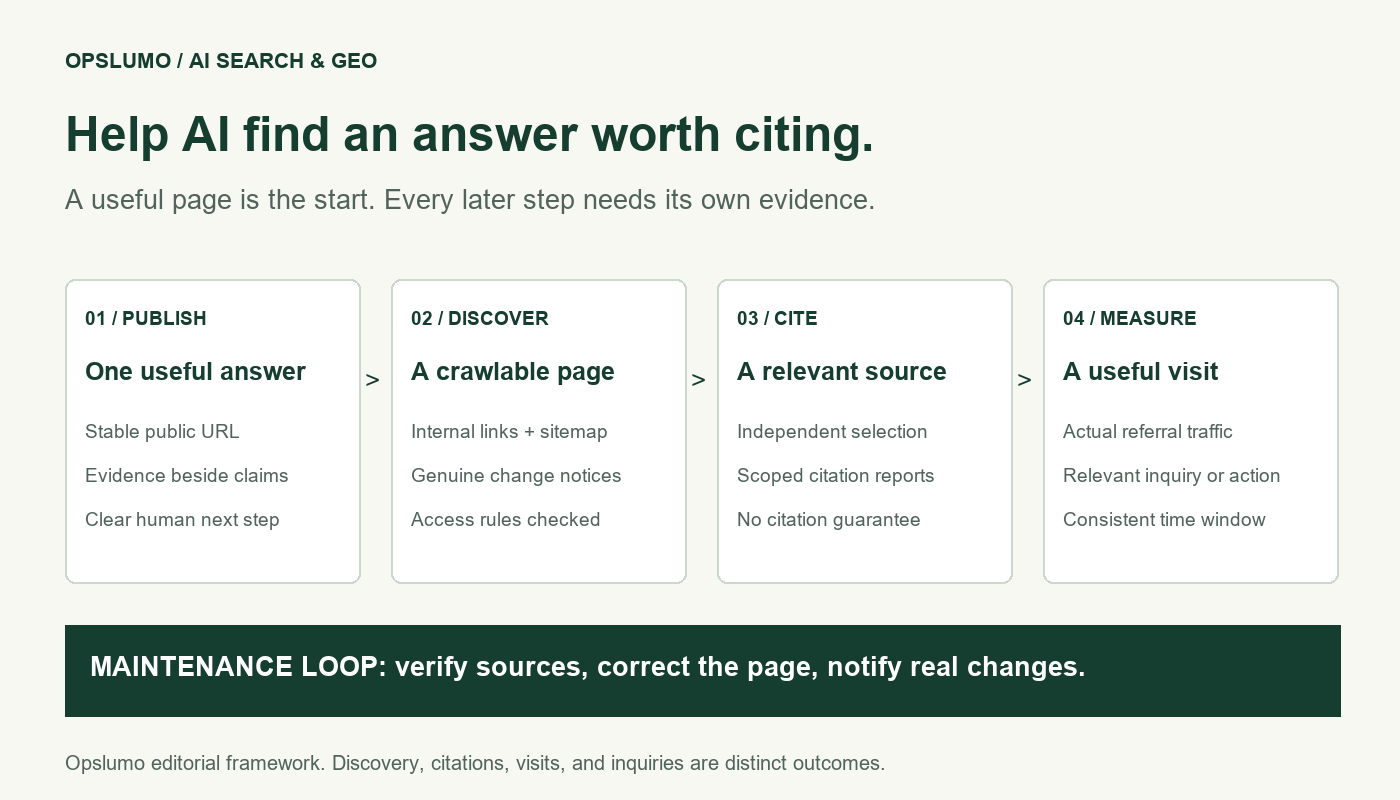
How do you get an AI answer to cite your website? Publish a useful answer on a stable, accessible page; make its evidence easy to check; help search systems discover changes; and measure citations separately from visits. Repeatedly pasting the article into a chatbot is not a documented route to inclusion in other people's search answers.
That distinction became more concrete this week. In an October 15 announcement, Cloudflare and OpenAI described a research pilot that uses network signals to help discover pages for OpenAI's search index. Cloudflare reports a participating cohort of roughly 1% of its network and hundreds of millions of newly discovered and indexed pages. Those are pilot-wide discovery figures, not traffic results for an individual publisher. OpenAI independently evaluates and ranks the pages.
For a small business, the useful question is what you can improve on one page this week. Here is a practical way to approach GEO, or generative engine optimization, without turning content maintenance into an endless conversation with a bot.
AI discovery, model training, and a chat upload do different jobs
OpenAI's crawler documentation distinguishes OAI-SearchBot, used for search, from GPTBot, which collects content that may be used for model training. Their permissions can be controlled independently. ChatGPT-User handles certain user-initiated visits and does not determine search inclusion.
That gives a publisher a more useful checklist than “feed the AI”:
- A public page gives search systems a URL they can retrieve and readers a destination they can visit.
- A sitemap or change notification helps communicate that the URL exists or has changed. It is not an instruction to cite it.
- An uploaded document or private knowledge base can support an assistant configured to use that material. It does not establish distribution to unrelated users or other AI products.
Before paying for an “AI submission” service, ask which system receives the URL, what acceptance means, and what evidence will show the result. A screenshot of your own prompted conversation answers a much narrower question than whether independent users are discovering the page.
Choose a question your customer actually needs answered
Consider an illustrative bookkeeping firm deciding what to automate after a customer inquiry arrives. “AI automation is transforming bookkeeping” offers little help. “What should a bookkeeping firm automate after an inquiry, before a human sends the reply?” has a clear decision behind it.
A useful answer could specify the input, the proposed action, its owner, the exception path, and the evidence retained. For example: the form captures the requested service and timing; an automation flags missing information and creates a draft brief; a person reviews it before sending anything. Sensitive client records stay out of this initial workflow.
Then explain what would change the recommendation. A solo bookkeeper handling a few inquiries may need a checklist more than a new integration. A team missing follow-ups may need an owner and a response rule before it needs an AI tool. These distinctions give readers a reason to visit the original page.
Our CRM follow-up guide covers the handoffs; the AI agent ROI article explains how to count human review in the cost.
Make each important claim easy to verify
Use a short answer near the top, descriptive headings, and source links beside material claims. For an original example, label the assumptions. For a measurement, include its date, population, and method. For a product announcement, distinguish released functionality from a preview or a future plan.
This is an editorial recommendation, not a special format required by an AI engine. Google's generative AI optimization guide puts the emphasis on useful, distinctive content and existing SEO foundations. It explicitly rejects special formatting requirements, mandatory tiny content chunks, and the idea that producing a page for every query variation creates quality.
For the bookkeeping example, show the actual decision rule and a fictional sample input with no customer data. A generic promise that an AI workflow saves time is less useful than a worked example showing what a reviewer must accept or reject.
Check the page that a visitor can actually retrieve
- Use one public URL. It should return the intended article, with a canonical URL that matches. Retain that address when updating the article.
- Keep the answer in the HTML. Readers should be able to access the core text without signing in. Images should support the explanation and have useful alternative text.
- Check crawl controls at both layers. Review robots.txt and the hosting or CDN rules. An allow rule in the former does not explain whether a security rule blocks the request later.
- Link the page from a relevant topic and another useful article. A page accessible only through a submitted URL is harder for people to find.
- Keep the next step relevant. An implementation checklist, related guide, or clearly scoped inquiry is more useful than sending every reader straight to a generic sales pitch.
Google's AI features documentation says supporting pages must be indexed and eligible for a Search snippet. Eligibility does not guarantee crawling, indexing, or selection. Special AI text files and special schema are not required for these Google features.
Likewise, the Cloudflare pilot does not mean that every Cloudflare-hosted site has joined it or earned a citation. The announcement describes discovery metadata rather than sharing page content for training. A page signal does not grant access permission.
Send genuine changes through discovery channels
When the article changes materially, update the visible revision date and the sitemap honestly. Notify participating engines through IndexNow where configured. Microsoft's AI Performance announcement describes IndexNow as a way to notify participating search engines of added, changed, or removed pages.
Repeating a notification for an unchanged page adds no new evidence. A better routine is to check the sources on a schedule, correct changed facts, add a genuinely useful example when available, and submit that revised URL once. Keep a small record of what changed and when.
Measure discovery, citations, visits, and inquiries separately
Microsoft's AI Performance reporting provides page-level citation activity across supported AI experiences. It distinguishes citation counts from ranking or placement in an individual answer. Keep that report's coverage attached to the result; it does not measure every AI service.
For one article, maintain four simple records:
- Discovery: published URL, submission receipt, and any available indexing status. A successful submission is still only a submission.
- Citations: the reporting surface, page URL, date range, and count. Keep manually sampled answers separate from aggregate reports.
- Visits: measured referral visits or sessions, with the analytics source and time window. A citation does not show how many people clicked.
- Useful outcomes: completed inquiries, relevant downloads, or another defined action. Review whether the visitor's need matches your offer.
Choose several real customer questions before looking at the results, then keep that question set stable. If you test an AI answer manually, do not include your brand or URL in the question when measuring unaided discovery. Record the date and whether search was used. The observation applies to that test, not to every user's answer.
The work worth repeating is source checking, correcting gaps, and reviewing outcomes. That creates a better destination for readers and a more defensible source for search. Our GEO evidence guide goes deeper into linking claims to proof; the small-business citation action plan turns it into a focused publishing cycle.
Sources and scope
- Cloudflare and OpenAI: making AI discovery better for everyone, October 15, 2026. Research-pilot discovery figures, independent ranking, and access controls. Vendor-reported results; no claim that Opslumo participated.
- OpenAI: Overview of OpenAI Crawlers. Search, training, and user-initiated agent roles.
- Google: Optimizing your website for generative AI features on Google Search. Content and technical guidance.
- Google: AI features and your website. Indexing and snippet eligibility.
- Microsoft Bing: Introducing AI Performance, February 10, 2026. Citation metric scope and IndexNow notifications.
Sources checked October 16, 2026. The example and operating checklist are Opslumo's recommendations, not a customer result or a guarantee of citation, traffic, or revenue.