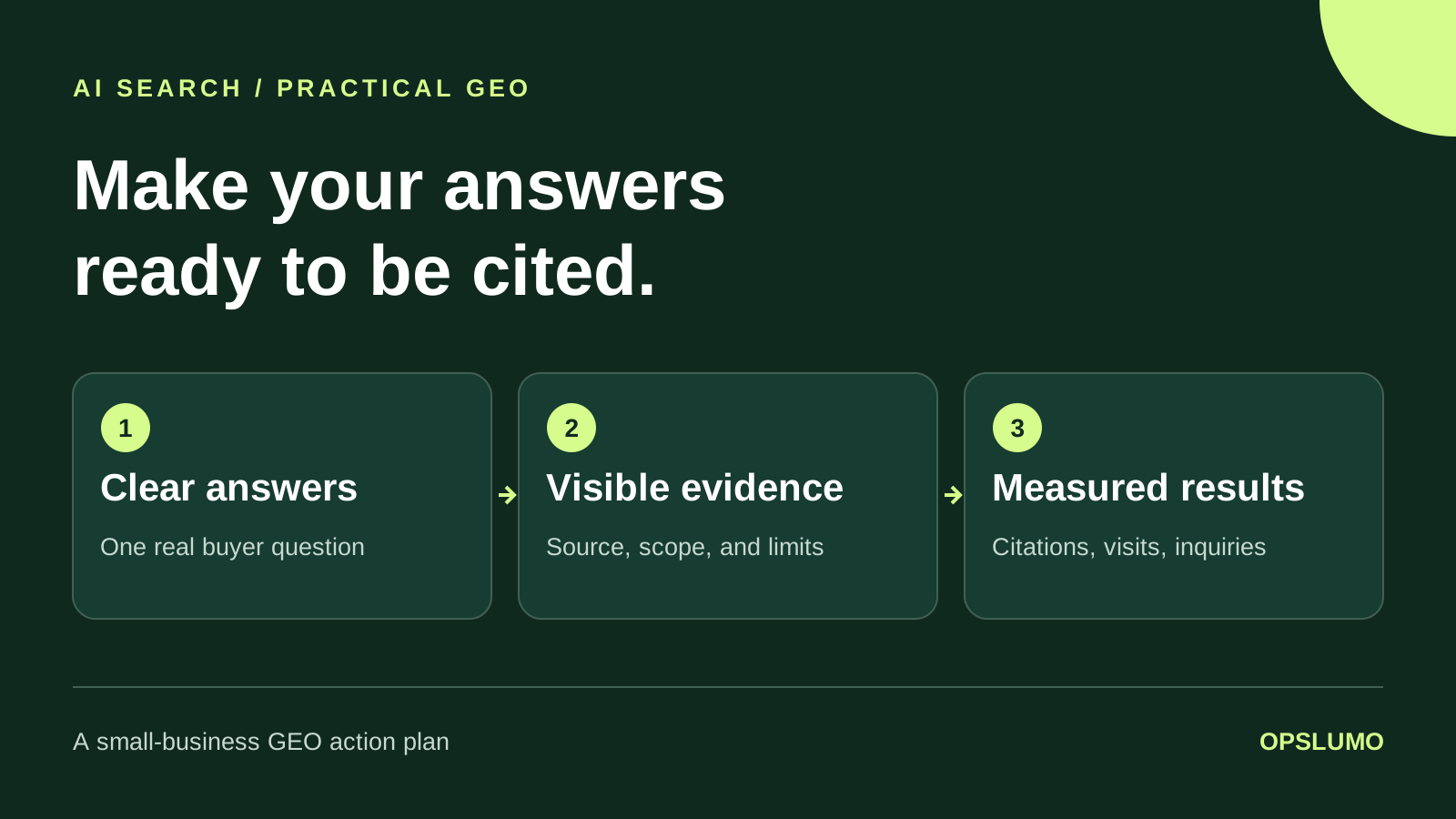
Direct answer: To improve a small business website’s chances of earning AI Overview citations, start with an accessible service page, answer specific buyer questions, and support important claims with evidence readers can inspect. Then measure observed citations, visits, and qualified inquiries separately. Rankings remain useful; neither rankings nor citations guarantee leads.
For Opslumo’s small-business audience, the useful question is practical: when search answers a question before someone visits your website, what should your service page do next? This guide focuses on Google AI Overviews and a repeatable measurement workflow. Findings about Google should not be assumed to apply to every AI assistant.
Do AI Overviews reduce organic clicks?
Research finds lower click-through rates in the studied searches, but it does not predict your website’s loss. In its February 2026 update, Ahrefs reported a 58% lower average position-one CTR associated with AI Overviews relative to its modeled comparison. It examined 300,000 keywords using aggregated desktop Search Console data from December 2023 and December 2025. This is an observational estimate, not a controlled experiment or a blanket 58% decline in business revenue.
Pew Research Center analyzed browsing from 900 U.S. adults in March 2025. Traditional results received clicks in 8% of visits with an AI summary versus 15% without; summary links received clicks in 1% of visits with a summary. Search results were collected later, in April, so changing answers are a limitation. These visit-level figures are different from Ahrefs’ position-one CTR and should not be combined.
The business implication is to check your own page and query trends. Separate informational questions from searches for a provider, compare similar periods, and examine actual inquiries before changing a budget.
Is getting cited more valuable than ranking first?
There is no universal winner: a citation creates another opportunity for discovery, while its value depends on the buyer question and the action that follows. A broad definition may expose your brand to students or other marketers. An answer about project scope, service suitability, or the evidence needed for an audit may reach a potential customer.
Do not assume that an AI-referred visitor is ready to buy. Inspect the landing page, referral information where available, inquiry fit, and accepted opportunities. A useful service page explains who it serves, what the buyer receives, and the next step without requiring the visitor to reconstruct the offer.
- Answer: address one real buyer question in a clear paragraph.
- Evidence: show the source, scope, method, and limitations.
- Discovery: verify access and record whether a linked citation is actually observed.
- Inquiry: offer a relevant next step and measure whether the inquiry fits.
This is an editorial checklist, not a measured conversion funnel. Each step can occur without the next.
What makes a page eligible for Google AI citations?
Google says a supporting page must be indexed and eligible for a search snippet. Its AI features documentation does not prescribe special AI schema or extra machine-readable files. Eligibility does not guarantee a citation.
Check the actual service-page URL for successful access, an appropriate canonical, index directives, readable HTML, and links from relevant pages. Review robots and hosting restrictions together. Search Console URL Inspection can help verify index status; a sitemap entry alone cannot establish that Google indexed a page.
Keep business identity, service descriptions, authorship, and visible dates consistent. Use structured data to describe what readers can see. For the evidence-writing method behind this checklist, see our GEO evidence framework.
What should a small-business service page actually say?
Answer the buying decision with deliverables and boundaries, then show evidence of the process. Use questions clients ask before approving work: what is included, what access is needed, what is outside scope, and what a useful result looks like.
Illustrative rewrite, not a client result
Before: “We use advanced GEO strategies to maximize your AI visibility.”
After: “A small-business SEO audit checks whether important service pages can be discovered, whether they match customer searches, and whether visitors have a clear path to inquire. Opslumo reviews technical blockers, search intent, service-page content, and authority gaps, then prioritizes fixes. Rankings and AI citations are not guaranteed.”
The second version describes the service Opslumo actually offers. To strengthen a page further, add an authorized sample deliverable, a documented diagnostic example, or an explanation of how priorities are scored. Label examples as examples. Do not invent client results, price ranges, turnaround times, or geographic coverage merely to make an answer look specific.
Which buyer questions should a small team monitor?
Start with ten questions connected to one service and one audience. The following are proposed audit-intent questions, not claims of measured search demand. Adjust wording and market context to match real inquiries.
- What does a small-business SEO audit include?
- Why are my service pages getting impressions but no inquiries?
- How can I check whether Google can index my service page?
- What should I fix before publishing more content?
- Can an SEO audit assess AI-search readiness?
- Do AI Overview citations require special schema?
- What evidence should a service page include?
- What access does an SEO auditor need?
- How should a small business prioritize SEO fixes?
- How can I measure whether AI visibility leads to inquiries?
Map technical requirements and audit scope to the service page; keep citation measurement on this guide and evidence design on the existing framework. This gives each page a distinct job and avoids publishing several articles that answer the same question.
How do you measure GEO reach without overstating it?
Use a documented question sample for citations and separate site data for outcomes. Google’s current AI features guidance says AI-feature traffic is included in Search Console’s Web performance reporting. Do not label the total Web impressions as isolated AI Overview impressions.
For each check, record the date, exact question, engine or surface, locale, login state, whether an AI answer appeared, the linked source URLs, and a saved answer or screenshot. Distinguish a linked Opslumo citation from an unlinked brand mention. Repeat under comparable conditions; personalized and changing answers make this a sample, not a population estimate.
- Observed citation coverage: checks with at least one Opslumo link divided by all completed checks. Report the counts and engine separately. If no AI answer appeared, record that outcome.
- Coverage within AI answers: cited checks divided by checks that produced an AI answer. Keep this denominator separate from all checks.
- Visits: landing-page sessions and identifiable referrals, with unknown attribution retained as unknown.
- Qualified inquiries: inquiries matching the service and customer fit; compare with accepted opportunities when available.
For example, three cited answers in twenty completed checks is 15% observed coverage. If only twelve checks produced an AI answer, coverage within those answers is 25%. These are hypothetical calculations, not Opslumo performance results. Small samples fluctuate; show counts and several observation dates before interpreting a trend.
What should you do during the next 30 days?
Run one documented improvement cycle on a commercially relevant page. Treat 30 days as a review interval, not a deadline for Google to index changes or generate citations.
- Days 1–3: choose the page, define a qualified inquiry, save baseline query checks and existing traffic data.
- Days 4–10: resolve material access issues, clarify the offer, add answer sections and inspectable evidence, and link from relevant pages.
- Days 11–27: repeat the same question set weekly and log page changes, answer availability, citations, and inquiries.
- Days 28–30: compare counts and fit. If evidence is sparse, extend observation. If exposure improves without inquiries, review the query audience, offer, proof, and contact path.
Common questions about AI Overview citations
Does GEO replace SEO?
No. For Google AI features, technical eligibility and useful search content remain foundational. GEO work can add disciplined answer design and citation monitoring to that foundation.
Can anyone guarantee an AI citation?
No. Search systems select sources dynamically. A provider can commit to specific audit work, content improvements, and reporting methods; it cannot control the generated answer.
Should every article include statistics?
No. Use statistics when they answer a relevant question and their source and scope are clear. A documented process or an honest worked example can be more useful than an unrelated percentage.
Start with the page that should earn the inquiry
Opslumo connects technical SEO, AI-search readiness, and practical lead-generation workflows for small teams. Start with an SEO audit to identify discovery and service-page gaps. If visitors arrive but do not inquire, review the lead-generation path. Share your website, target customer, and the page you want to improve so the review begins with a concrete business question.
Sources and verification notes
- Ahrefs: Update: AI Overviews Reduce Clicks by 58%. February 4, 2026. Observational desktop CTR analysis; not a business-specific forecast.
- Pew Research Center: Google users are less likely to click when an AI summary appears. July 22, 2025. U.S. browsing sample; March activity and April result collection.
- Google Search Central: AI features and your website. Official eligibility, technical, and reporting guidance. All three sources checked September 5, 2026.
The page example, question set, formulas, and 30-day workflow are Opslumo editorial recommendations. They are not experimental evidence of increased citations.