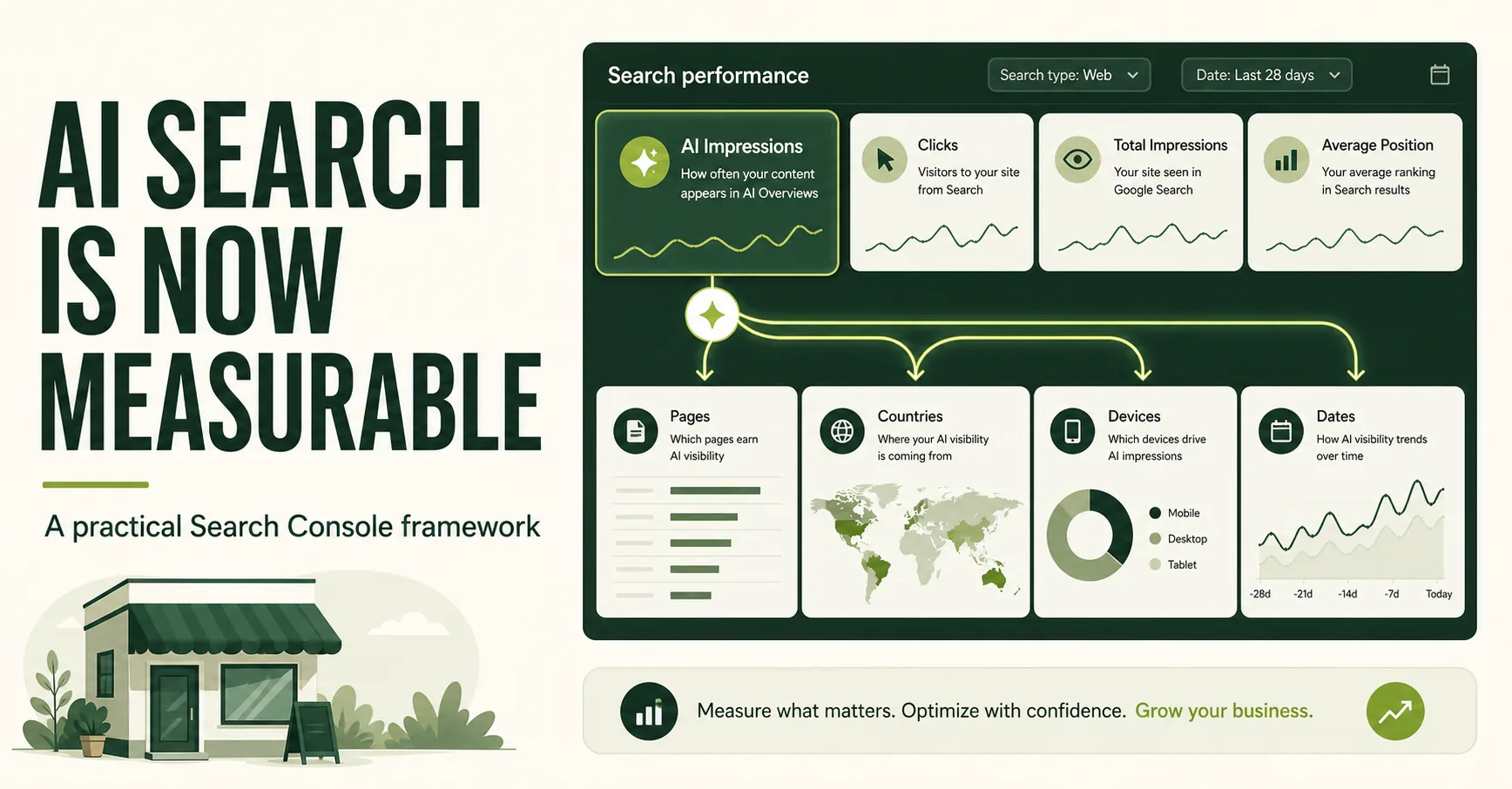
Conclusion: AI visibility has become observable, not fully attributable.
The evidence: Google announced dedicated Search Console reports for generative AI features in Search and Discover. The test reports expose impressions, appearing pages, countries, devices, and dates for experiences such as AI Overviews and AI Mode. Google is initially rolling the feature out to a subset of websites.
The analysis: This closes an important measurement gap: a site owner can see whether content appears inside an AI-generated search experience. It does not show that the appearance caused a sale, or even a visit. Treat the report as an exposure layer that sits above clicks, conversions, and revenue—not as a replacement for them.
Conclusion: Start with the pages that appear, not the total impression count.
The evidence: Google's report includes a Pages view specifically so site owners can identify which URLs appear in generative AI features. That page-level evidence is more actionable than a single sitewide total.
The analysis: Group appearing pages by commercial role: service page, guide, comparison, case study, or company proof. Then ask whether the pages represent the services you want to sell. If an informational guide earns visibility but the relevant service page remains absent, strengthen the internal path from explanation to offer. Our framework for moving from AI visibility to qualified inquiries explains what that commercial handoff requires.
Conclusion: Country and device data should change the decision, not decorate a report.
The evidence: Google says the new reports break out visibility by country and, for Search, by device. Dates can be reviewed at hourly, daily, weekly, and monthly granularity.
The analysis: A local firm should question impressions from markets it cannot serve. A mobile-heavy pattern should trigger a review of mobile readability, page speed, tap targets, and short conversion paths. A temporary spike should be compared with a product announcement, new page, media mention, or seasonality before anyone claims a durable gain. For high-urgency demand, see how a search spike can expose the quality of a response system.
Conclusion: Rankings can remain stable while discovery changes.
The evidence: LinkedIn's B2B organic growth team reported that non-brand, awareness traffic declined by up to 60% across a subset of B2B topics after AI Overviews expanded, while click-through rates softened even when rankings stayed stable.
The analysis: A stable ranking no longer guarantees stable traffic. The result page itself can now satisfy part of the research journey. This makes clear definitions, original evidence, named examples, and useful comparison criteria more valuable: they can support visibility inside an answer even when the user does not click immediately.
Conclusion: Measure a chain of evidence, not one fashionable metric.
The evidence: Google's new report measures exposure. Search Console already measures clicks and conventional search performance, while analytics and the inquiry system record later actions.
The analysis: Use a four-stage scorecard:
- Exposure: AI impressions, appearing pages, countries, devices, and trend direction.
- Engagement: search clicks, landing-page engagement, branded searches, and assisted visits.
- Conversion: form submissions, booked calls, replies, and qualified inquiry rate.
- Business value: accepted opportunities, sales cycle, revenue, and unsuitable-lead rate.
One number can rise while the system weakens. For example, more AI impressions from the wrong country can increase exposure without improving demand. A useful dashboard keeps every layer visible.
Conclusion: Answer-first pages need evidence, not keyword repetition.
The evidence: LinkedIn's own AI-led discovery work found that headings, logical information hierarchy, accessible text, and semantic markup improve how generative systems interpret content. Its team also focused on correcting misinformation, expanding depth, and aligning signals across owned and social content.
The analysis: Give each important page a direct claim followed by support: a real process, scope, limitation, example, calculation, credential, source, or dated observation. A vague paragraph rewritten with more occurrences of “AI SEO” is still vague. A page that answers a buyer's question and shows why the answer is defensible becomes useful to both people and retrieval systems. These are also the foundations behind the AEO visibility signals a small business should track.
Conclusion: Run a 30-day measurement test before scaling content.
The evidence: The new reporting can be reviewed over time and at page level, which makes a controlled test possible.
The analysis: Select five commercially important pages. Record their baseline AI visibility, conventional impressions, clicks, and inquiries. Improve one weak evidence block on each page, add relevant internal links, confirm indexability and structured data, and document the change date. Review the same metrics after 30 days. Keep changes that improve relevant exposure or qualified demand; do not reward volume alone.
The practical rule: AI impressions tell you where your evidence is being surfaced. Your website and follow-up process determine whether that visibility becomes trust and revenue.
Sources and methodology
This article uses current platform announcements and published operational findings. Percentages describe the cited studies and should not be treated as guaranteed results for another website.