For years, search visibility was represented by a familiar set of numbers: ranking position, impressions, clicks, and conversions. AI assistants have made the path less visible. A customer can now ask for a recommendation, receive a synthesized answer, and form an opinion without opening ten blue links. The business may be cited, mentioned without a link, briefly included, or left out entirely.
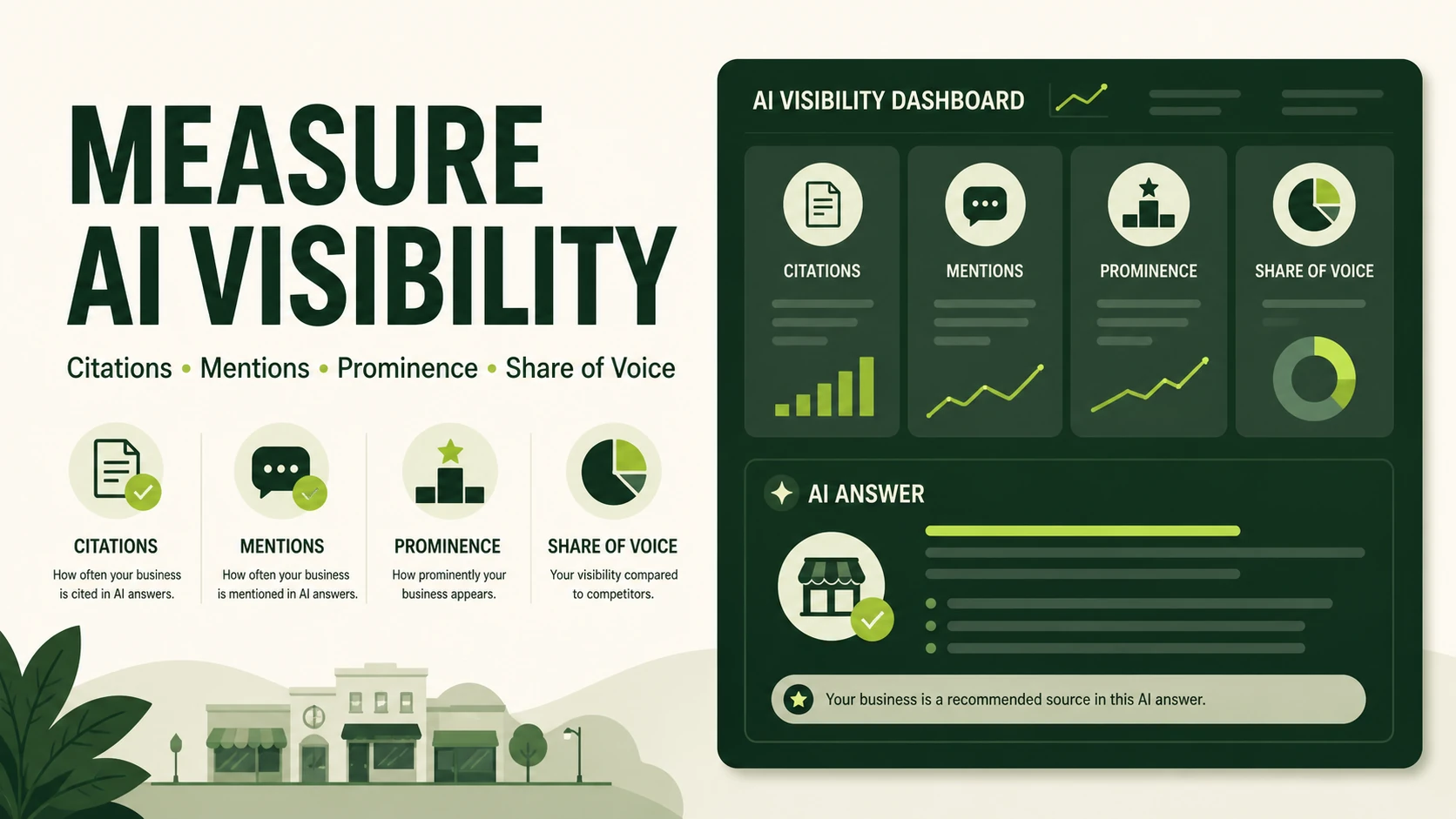
This month, Cloudflare announced an AEO Visibility Dashboard designed to show whether AI assistants cite, mention, and recommend a brand. The significance is larger than one product launch. It shows that answer engine optimization—usually shortened to AEO—is moving from speculation toward observable signals.
Small businesses do not need to abandon SEO or chase a new acronym. They do need a more complete measurement model.
Start with reachability, not recommendations
An AI system cannot use a page it cannot reach or understand. Before measuring citations, confirm the same technical basics that support ordinary search: important pages return a successful response, robots rules do not block necessary crawlers, the sitemap is current, canonical URLs are consistent, and the primary content is present in readable HTML.
Structured data can clarify the organization, service, location, author, and article relationships on a site, but it does not replace clear writing. A service page should still state who the service is for, what problem it solves, where it is available, what the process includes, and how a prospect can take the next step.
The first AEO metric is not a citation. It is whether machines can reliably discover, interpret, and attribute the business information on the page.
Four AI visibility signals worth understanding
1. Citation rate
Citation rate asks how often an AI answer links to or explicitly sources the website for relevant questions. For a local bookkeeping firm, that might include questions about catch-up bookkeeping, payroll support, QuickBooks cleanup, or bookkeeping for a specific industry and city.
A low citation rate is not automatically a content problem. The site may be inaccessible to a particular crawler, the page may lack a clear answer, or a stronger source may provide more specific evidence. Diagnosis comes before rewriting.
2. Mention rate
A business can be named without its website being cited. That is still a visibility signal. Mentions may come from review platforms, professional directories, news coverage, customer discussions, or other sites that establish the entity independently.
If a firm is mentioned but rarely cited, the brand may have awareness while the website lacks sufficient authority or useful source material. If it is neither mentioned nor cited, the problem may be more fundamental: weak local signals, indistinct positioning, limited third-party evidence, or pages that do not match the questions customers ask.
3. Prominence
Not every appearance has equal value. A brief name in a long list differs from a specific recommendation supported by a description of the firm's expertise. Prominence considers where and how substantially the business appears in an answer.
This is why generic “we provide excellent service” copy performs poorly as evidence. Specificity creates material an answer system can use: client type, geographic coverage, credentials, service boundaries, process, pricing logic, and verifiable examples.
4. Share of voice across real questions
AI share of voice compares a business with competitors across a controlled set of customer questions. The phrase “controlled set” matters. Random prompts produce noisy conclusions. A small business should track a compact, stable question set tied to revenue: service comparisons, local recommendations, industry-specific problems, and high-intent buying questions.
Run the same questions over time, record the source and date, and note whether the business was cited, mentioned, recommended, or absent. This is directional research, not a perfect ranking report.
Do not optimize for AI by weakening the website
The wrong response to AEO is to generate large quantities of repetitive pages or insert unnatural question-and-answer blocks everywhere. That creates more URLs without creating more evidence. It can also make the site less useful to the people who ultimately decide whether to inquire.
A stronger approach improves the information customers and machines both need:
- one clear page for each meaningful service and audience;
- plain-language explanations of process, scope, and fit;
- accurate organization, location, and author details;
- first-party experience, examples, and original data where available;
- consistent facts across the website, Google Business Profile, LinkedIn, and trusted directories;
- internal links that connect related services, proof, and next steps.
These are recognizable SEO fundamentals. The difference is that success is no longer measured only by whether a page ranks and receives a click. It also includes whether the business becomes part of a useful answer.
A practical 30-day measurement plan
Begin with ten to twenty questions that a qualified customer could realistically ask. Divide them into four groups: local discovery, service selection, problem diagnosis, and provider comparison. Record the current answers from the AI systems your customers are likely to use, along with citations and named competitors.
Next, map each question to the strongest page on the site. If no page deserves to support the answer, that is a content gap. If the page exists but is vague, improve its clarity and evidence. If the page is strong but inaccessible, fix the technical problem. If third-party sources dominate the answer, strengthen consistent profiles and pursue legitimate coverage or partnerships rather than manufacturing mentions.
Recheck the same question set monthly. Combine the findings with Search Console impressions, website conversions, branded search demand, referral traffic, and qualified inquiries. No single AEO metric should become the goal by itself.
The business outcome still matters
A citation is useful only when it helps the right customer understand and trust the business. An increase in AI visibility that produces irrelevant traffic or no qualified demand is not a successful strategy. The measurement system should therefore connect visibility to the next part of the journey: the service page, the offer, the inquiry, and the follow-up process.
AI search is changing what can happen before a visitor reaches the website. It does not remove the need for a clear proposition, credible evidence, and a reliable way to turn interest into a conversation. Small businesses that build those foundations now will be easier to evaluate in both traditional search and AI-generated answers.