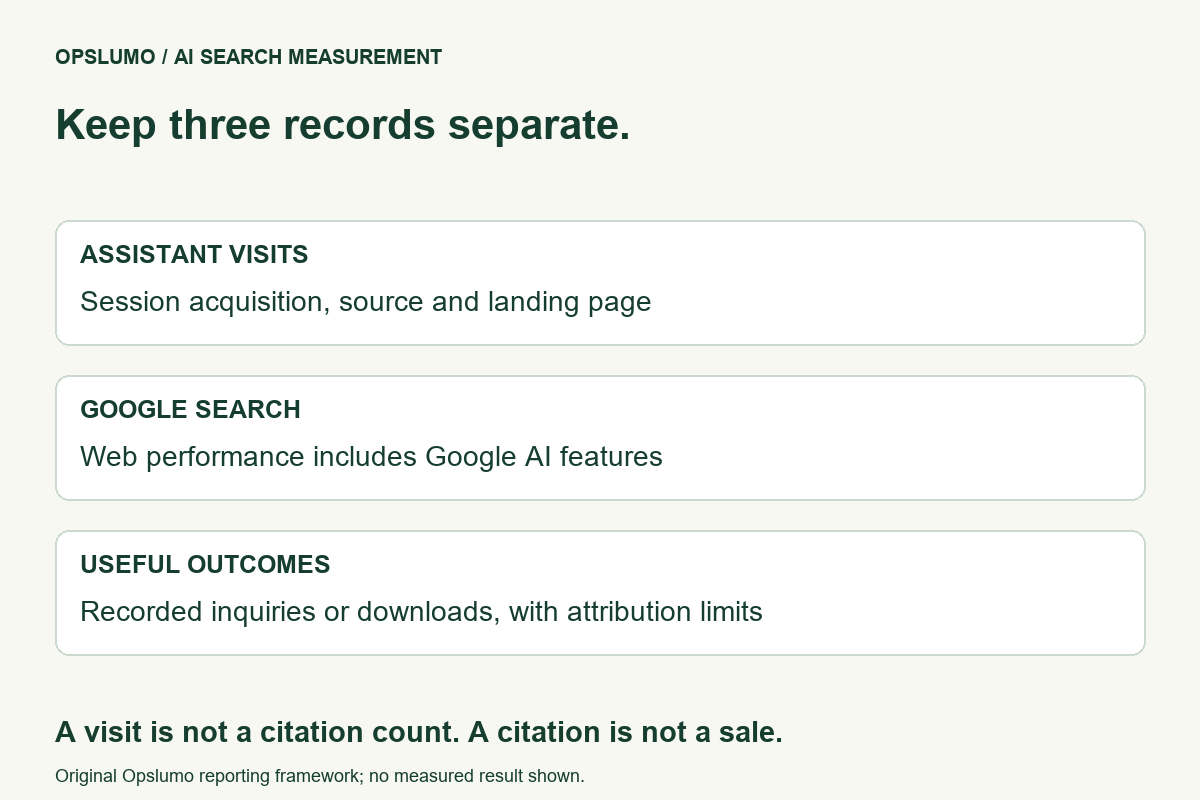
How can a small business measure traffic from AI assistants? Start with session-level acquisition data, inspect the landing pages and sources behind it, and record useful outcomes separately. Keep Google's AI search traffic distinct from visits attributed to other assistants. Neither report tells you how many times an AI answer mentioned your business without a click.
A channel label is a starting point for investigation. It is not a complete account of how someone discovered you. For a small team, a consistent weekly record is more useful than a dashboard that turns every change into a GEO success story.
Check which kind of AI traffic you mean
Google's Analytics channel documentation currently defines an AI Assistant channel for sources such as ChatGPT, Gemini, Deepseek, Copilot and Grok. It excludes Google's AI Overviews and AI Mode. Google places non-ad search visits, including those Google AI features, in Organic Search.
The same documentation distinguishes session, first-user and event scopes. Session default channel group describes the channel associated with a new session; first-user scope describes initial acquisition. Do not switch between them in a trend comparison without explaining the change.
Before changing an existing report, save its dimensions, filters and date range. If your property does not show the expected label, inspect the available source and medium values. Do not manually relabel all referral or direct visits as AI traffic.
Build one small weekly record
Our suggested record has five fields: reporting window and timezone, acquisition scope, observed sessions, landing pages, and the outcome you care about. Add a note for missing access or incomplete measurement. An unavailable report is not zero traffic.
- Choose a settled reporting window and retain the same timezone.
- Use session acquisition dimensions when your question is about visits arriving during that window.
- Inspect source and medium alongside the channel, then identify the landing pages.
- Review an outcome such as a completed inquiry or download separately from the session count.
- Write down instrumentation changes before comparing with the previous window.
This is an editorial workflow, not a claim that every Analytics property has the same configuration or complete coverage. Check what your own account actually measures before drawing conclusions.
Keep Google Search evidence separate
Google Search Central says AI Overviews and AI Mode are included in overall Search Console Web performance. A rise in a page's Web clicks alone does not identify which individual visits came through an AI answer.
Use Search Console to investigate search visibility and page performance. Use Analytics to investigate recorded visits and on-site behavior. Keep each tool's metric names and reporting windows attached to the result rather than expecting their totals to match exactly.
For example, a page can receive search impressions without a visit. A visitor can reach the article and leave without submitting an inquiry. An inquiry can be recorded without reliable source attribution. These are different observations, and each can help locate a gap.
Read a result without overstating it
Consider a fictional weekly review: an article has recorded sessions attributed to an assistant source, but no completed inquiry is linked to those sessions. The defensible statement is that the report recorded visits under that source and window. It does not establish that the article generated sales, that every visitor saw an AI citation, or that all assistant traffic was captured.
If the next week shows more sessions, inspect which landing pages changed and whether your tracking changed. Keep small counts visible instead of presenting a large percentage increase without the underlying numbers. If you cannot access the report, record that limitation and postpone the comparison.
Let the landing page guide the next edit
Once you know which article people reach, review the question it answers. Is the direct answer easy to find? Are important claims supported by original sources? Does the next link help the same reader continue their task?
A useful follow-up might be a worked example, a relevant checklist or a related guide. Choose the next step because it helps the reader, then measure whether it is used. Do not turn an increase in sessions into an assumed improvement in qualified demand.
Our citation-checking guide covers evidence review before publication. The AI discovery guide explains why publication, indexing, citation, visit and inquiry need separate records.
Sources and limits
- Google Analytics: Default channel group. Current channel definitions and acquisition scopes.
- Google Search Central: AI features and your website. Search eligibility and performance-report coverage.
Sources checked November 1, 2026. This guide describes the documentation available on that date, not a newly announced launch or an analysis of Opslumo traffic. The review process and fictional example are Opslumo recommendations. No citation, traffic or revenue outcome is guaranteed.