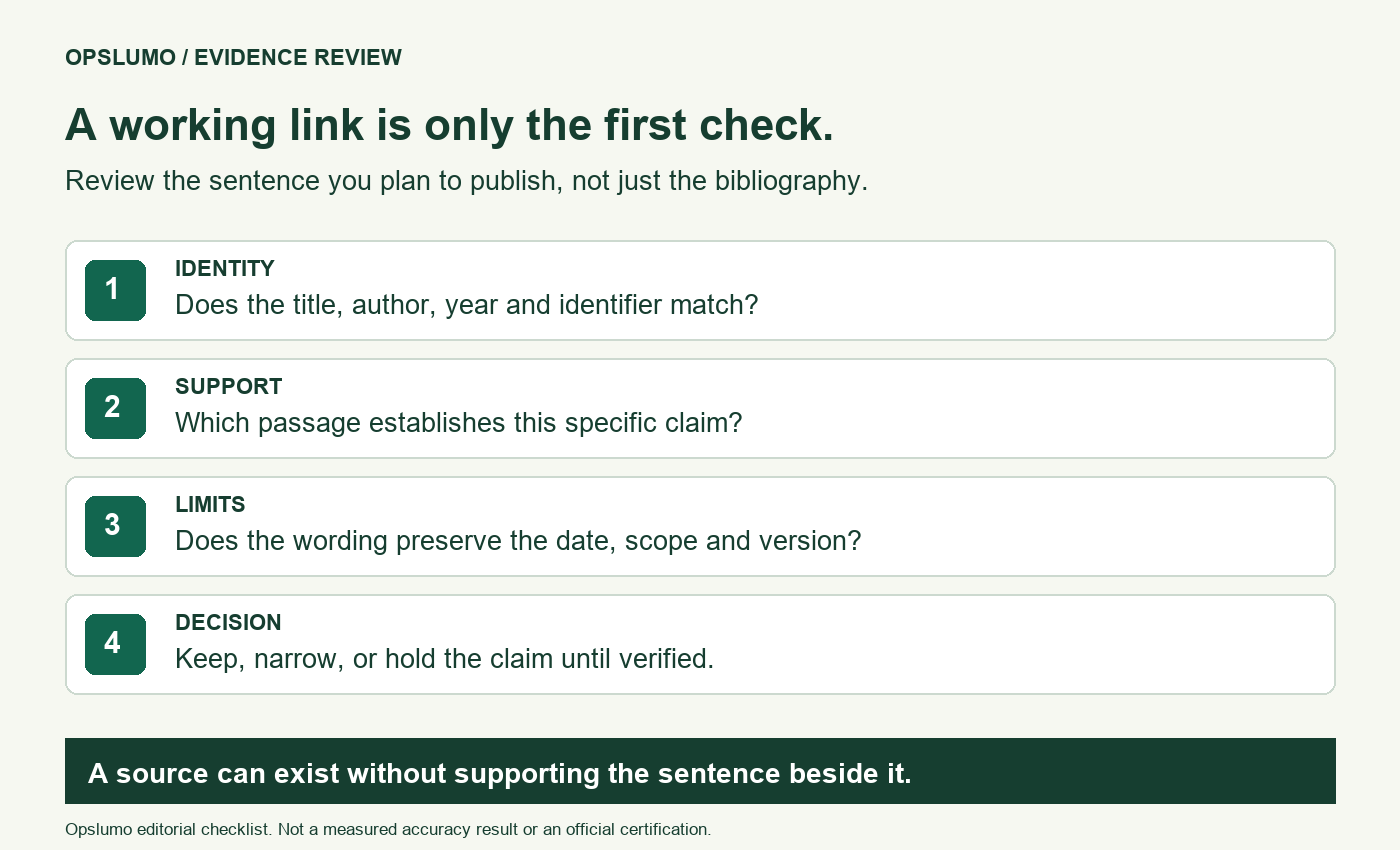
How should a small team check citations in an AI-generated draft? Open the original source, match its identity, find the passage that supports the claim, and check its date and scope. Keep the claim out of the published draft until a reviewer can explain what the source actually establishes. A working link alone is not enough.
A familiar editing problem starts with a tidy paragraph and three impressive references. One reference exists but discusses a different population. Another describes a proposed feature as though it has shipped. The third cannot be found. These are illustrative failure cases, not results from a study of any particular model.
This guide is for a small team preparing a blog post, sales brief, or internal research note. It offers a review process you can use without buying another tool.
Why a bibliography needs its own review
NIST's Generative AI Profile, published in July 2024, describes confabulation as confidently presented erroneous or false content. Section 2.2 includes fabricated citations among the risks. Suggested action MS-2.5-003 calls for reviewing and verifying sources and citations in generated outputs during evaluation and ongoing monitoring.
That is a reason to inspect references, not a measured error rate for your assistant. The profile does not tell you how often your current model invents sources or whether a particular draft is correct.
Set the boundary before drafting: the assistant can propose evidence; the person approving publication decides whether each material claim is supported. Asking the same assistant to confirm its answer can help locate a passage, but its confirmation does not replace reading that passage.
Start with the sentence, not the reference list
Copy each consequential factual claim into a short review sheet. Prioritize numbers, comparisons, product capabilities, and statements a reader might use to make a decision. Separate recommendations from external facts.
For example, “We suggest reviewing the first ten drafts before automating publication” is an editorial proposal. “This workflow reduces review time by half” is a performance claim that needs evidence. Do not attach a general AI report to the second sentence and assume the report supplies the missing measurement.
Use these fields for each claim:
- The exact sentence proposed for publication.
- The original source URL, title, author or issuing organization, and publication date.
- The supporting section, page, or short passage.
- The population, period, product version, or other limit that affects the claim.
- The reviewer's decision: supported, narrower wording needed, or unverified.
This is Opslumo's suggested review record. It is deliberately small enough to maintain alongside a draft.
Check whether the source is the one the draft names
Open the publisher's page or original document. Compare the title, author, year, and identifier with the reference in the draft. A plausible title is not a match. A search snippet can help find a document, but it is a poor substitute for the document itself.
For scholarly references registered with Crossref, its public REST API documentation explains how to retrieve bibliographic metadata deposited by members and trusted sources. No sign-up is required. A team can use that metadata to compare a DOI's title, authors, and publication details with an AI-produced reference.
Use that check for identity, not as proof of the paper's conclusion. Crossref metadata is not the full argument or a guarantee of research quality. An item absent from a Crossref lookup is not automatically fabricated: it may use another registration agency or have no DOI. Look for the original publisher or issuing institution before making that judgment.
If you cannot locate the source, mark the claim unverified. Do not let the model repair the bibliography by generating another plausible identifier.
Check whether the source supports this particular claim
Read the relevant passage and enough surrounding text to understand its limits. Ask what was observed, who or what was included, when it happened, and what was not tested. For product documentation, confirm the exact feature, release status, and applicable version.
Here is a fictional example. A vendor announcement says a feature is available to selected pilot participants. Your draft says every small business can use it today. The source exists, yet the sentence overstates availability. The correction is to describe the pilot accurately, not to add more links to the overstatement.
Apply the same discipline to numbers. Keep the denominator and time window beside the figure. Do not turn a survey of one vendor's customers into a result for all businesses, or a laboratory test into a forecast for your team's operations.
When only an abstract is accessible, state that limit. Do not imply you reviewed methods or supplementary material you could not access. If a secondary article is all you can read, attribute it as a secondary account.
Make a decision before publishing
For each material claim, choose one of three outcomes:
- Keep: the original source supports the wording, and the necessary limits are visible.
- Narrow: the evidence supports a smaller statement. Rewrite it and check the revised sentence.
- Remove or hold: the source is missing, inaccessible for the needed check, or does not establish the claim.
Uncertainty is useful information. A sentence such as “The announcement describes a pilot; general availability was not established by the source we checked” is more informative than a confident launch claim.
After editing, check the final draft again. A later rewrite can drop a qualification or move a citation beside a different sentence. Keep links close to the claims they support, and ensure diagrams express the same limits as the text.
Put the check in the publishing workflow
Give one person responsibility for the evidence record. For a routine article, they can review material claims before release and retain the checked date. For consequential specialist claims, involve a reviewer with the relevant expertise rather than treating this checklist as sufficient by itself.
When a source changes, record what changed and correct affected wording. Our guide to workflow retries explains another boundary worth keeping explicit: an attempted action and a confirmed result are different states. Evidence review benefits from equally clear states.
For GEO, the practical value is a page readers can verify. Our GEO evidence guide covers the relationship between claims and proof. Neither citation checking nor adding a bibliography guarantees that another AI system will cite your page.
Sources and scope
- NIST AI 600-1: Generative Artificial Intelligence Profile, July 2024. Section 2.2 and action MS-2.5-003 support the discussion of fabricated citations and verification.
- Crossref: REST API documentation. Supports the description of bibliographic metadata retrieval and access.
Sources checked October 26, 2026. The review sheet, fictional examples, and publishing decisions are Opslumo's editorial recommendations. This guide reports no model error rate, customer outcome, or guaranteed search benefit.