A governed AI skill is a reusable instruction set tied to approved evidence, constrained permissions, clear human approval points, and logged outcomes. Without those boundaries, sharing a good prompt can scale ambiguity as quickly as it scales productivity. Small businesses do not need enterprise bureaucracy to avoid that mistake. They need a visible workflow that makes the skill’s inputs, decisions, actions, owner, and recovery path explicit.
The weekend signal is not “Google Docs is popular.” It is that documents are becoming executable context.
FindNews recorded “Google Docs” at a seven-day search-volume peak of 200,000 in its August 30 snapshot. That number is a multi-source relative trend signal, not proof of why people searched or how many became buyers. The more useful evidence comes from Google’s August 26 Workspace product update: Workspace Studio skills can package reusable prompts, team rules, templates, and reference files, then make them available through Gmail, Docs, Slides, Drive, and Chat.
The product announcement matters because it reduces the distance between a written standard and an automated action. A brand guide can shape an email draft. A proposal template can become a repeatable production rule. Meeting notes can feed a status update without requiring the same material to be uploaded again. Google also announced agent access management and data-loss-prevention controls that can suspend agents, revoke scopes, restrict data use, or enforce end-user review. The capability and the controls arrived in the same update for a reason: reusable instructions become operational infrastructure when a team can invoke them everywhere.
For a small business, the decision is therefore not whether to “use AI in Docs.” It is which recurring judgment should become reusable, which evidence is trustworthy enough to support it, and where the workflow must stop for a person.
A shared prompt becomes infrastructure when other work depends on it.
A private prompt can be revised casually because its author holds the surrounding context. A shared skill is different. Colleagues may invoke it from another application, with another customer record, under time pressure, without knowing why a particular instruction exists. If the result is copied into a proposal, sent to a prospect, or used to update a tracker, the prompt has crossed from personal assistance into process design.
That transition changes what “good” means. Fluency is not enough. The skill needs a named purpose, a defined input, an expected output, an owner, and a boundary for exceptions. It should say which reference material is authoritative and what to do when sources disagree. It should distinguish drafting from deciding. It should also expose the moment when generated language could create a commitment the business must honor.
This is the same reason a reliable workflow automation project starts with the process rather than the tool. The AI instruction is one component. The surrounding system determines whether the result is current, reviewable, recoverable, and useful.
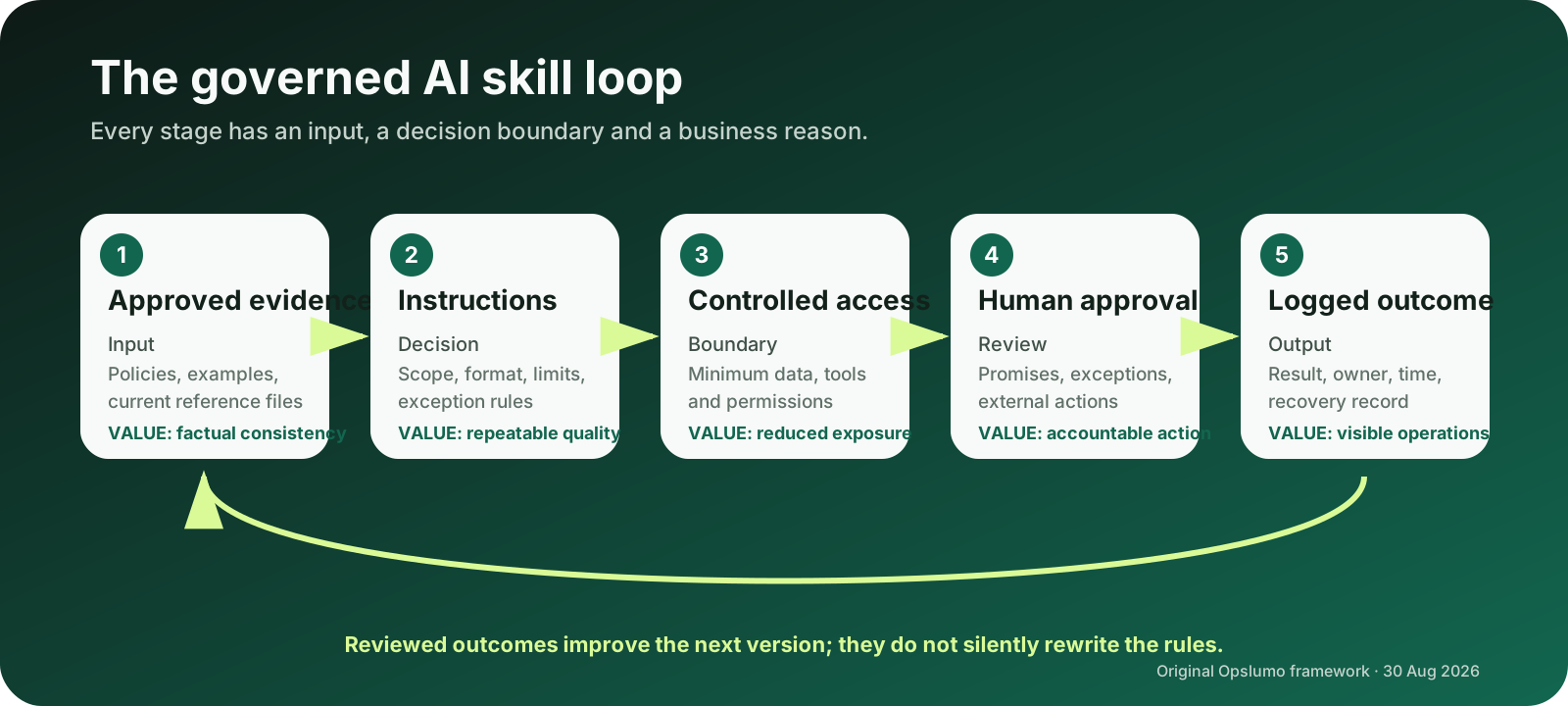
Evidence should be versioned before instructions are optimized.
Most prompt improvement work focuses on wording. In production, evidence quality is usually the harder constraint. A proposal skill may sound consistent while relying on an expired price sheet. A lead-summary skill may organize the wrong fields because the qualification standard changed. A status-update skill may repeat a meeting note after the underlying decision was reversed.
The practical fix is to separate reference evidence from reusable instructions. Name the approved files. Record who maintains them and when they were last reviewed. Make the instruction cite or identify the evidence it used when the output matters. If a reference is missing, stale, or contradictory, the skill should produce a visible exception instead of manufacturing certainty.
This separation also improves AI-search visibility. Pages and systems are easier to trust when factual claims have a stable source, a date, and a responsible entity. Generic assertions are difficult for a buyer—or a retrieval system—to verify. Evidence with clear provenance creates material that can be evaluated, attributed, and cited.
Access is part of the workflow, not an installation detail.
Google’s Workspace documentation warns that variables passed to third-party integration steps can contain Google Account data from Gmail, Chat, or Calendar and may share that data with another service. This is not a reason to reject integrations. It is a reason to design the data boundary before connecting them.
A useful workflow asks for the minimum information required at each stage. A lead-classification skill may need the inquiry text and source page, but not an entire mailbox. A reporting workflow may need aggregated status fields, but not every underlying document. A follow-up draft may need the customer’s stated problem, yet pricing authority can remain outside the AI step. Minimum necessary access reduces exposure and makes failures easier to understand.
The same principle applies to actions. Google notes that a test run can take real actions. A workflow that can send, publish, update, or disclose information should be tested with controlled inputs and a safe destination. “It worked once” is not sufficient evidence that its permissions and exception paths are appropriate.
Human review should be placed at the decision boundary.
Human review is often added as a vague final instruction: “check the result.” That does not identify what the reviewer is responsible for. A better design locates review immediately before a consequential action and gives the reviewer the evidence needed to decide.
For an inquiry workflow, AI can extract the company, requested service, missing details, urgency, and source page. It can draft a response that asks for the missing information. The reviewer should still own claims about scope, pricing, deadlines, legal or financial implications, and any promise sent outside the business. Routine drafts can move quickly because the boundary is explicit; exceptions become visible because they cannot quietly pass as ordinary work.
Google’s new Studio controls include the ability to enforce end-user review based on sourced data, utilized data, and output visibility. The broader lesson applies beyond one platform: review is most valuable when it is triggered by risk conditions, not added indiscriminately to every low-value step.
Logs and recovery turn automation into an operable system.
A workflow is not complete when it produces an output. The business needs to know when it ran, what it used, what it produced, who reviewed it, and what happened next. Google Workspace Studio exposes activity and error history for flows. NIST’s Cybersecurity Framework 2.0 gives small businesses a broader lifecycle—Govern, Identify, Protect, Detect, Respond, and Recover—for thinking about the same operational responsibility.
Logging makes quality measurable. A team can see whether a skill repeatedly lacks a particular input, whether approvals are delayed, or whether one exception class creates most of the rework. Recovery makes automation reversible. The original inquiry, approved template, final message, and current record should remain available even if the generated draft is wrong or an integration fails.
This is not heavy governance. It is the minimum structure required to answer a practical question after something goes wrong: what happened, what changed, and how do we return to a known state?
A small-business example: governed inquiry follow-up.
Consider a service business that receives inquiries through a website form and email. The approved evidence consists of the current service definitions, qualification questions, response standard, and escalation rules. The reusable skill summarizes the request, identifies missing information, and drafts a response in the company’s tone. Access is limited to the submitted inquiry, its source page, and the approved references rather than the full mailbox.
The skill is allowed to create a draft and update an internal status field. It is not allowed to send pricing, promise a start date, or reject a prospect. A person reviews those decisions. The final message, reviewer, timestamp, and next action are logged. If the automation fails, the original inquiry remains in the inbox and a response-time alert still assigns ownership.
This design does not claim that AI replaces judgment. It uses AI to reduce repetitive preparation while keeping commercial accountability visible. It also creates better operational evidence than an informal chain of copied prompts and untracked drafts.
GEO begins with information that deserves to be cited.
Generative search optimization is sometimes presented as a new layer of keywords. A stronger interpretation is evidence architecture. An AI system can more confidently use a page when the page states a direct answer, defines its terms, explains the mechanism, marks its limitations, names its sources, and connects the claim to a consistent organization and author.
This article follows that pattern intentionally. The trend number is labeled as a FindNews signal rather than a market-size claim. Product capabilities are attributed to Google’s dated announcement and help documentation. Governance principles are connected to NIST guidance. The five-stage model is identified as an original Opslumo framework rather than an industry standard. Those distinctions help readers and machines separate observation, source evidence, and analysis.
The same structure should carry into service pages. A clear SEO and AI-search readiness audit can identify where a site is hard to discover or hard to trust. A source-aware lead follow-up workflow can then preserve the context that brought a qualified prospect to the business.
Start with one skill whose failure is visible and recoverable.
A sensible first project has a stable trigger, repeatable evidence, a useful draft output, and a clear owner. Run representative examples and known exceptions through it. Compare the result with an approved standard. Verify which data crosses each boundary. Place approval before external actions. Confirm that the original record survives a failed run. Only then should the skill become widely shared.
During the first month, review outcomes rather than celebrating run counts. Look for missing inputs, unsupported claims, repeated corrections, slow approvals, permission requests, and recovery events. Use those observations to revise the evidence and rules deliberately. Do not allow generated output to silently become the new policy.
The practical rule: reuse instructions only after you can explain their evidence, access, approval, logging, and recovery. That is how a useful prompt becomes a dependable business process.
Frequently asked questions
What is a governed AI skill?
It is a reusable instruction set connected to approved evidence, limited data and tool access, explicit review rules, and a logged outcome. Governance describes the operating boundary around the instruction, not merely the wording of the prompt.
Where should a small business require human approval?
Approval should sit before actions that create commitments, disclose sensitive information, change important records, send external communications, or handle an exception the workflow cannot resolve safely.
How should a small business test an AI workflow?
Use representative examples and known exceptions, compare outputs with an approved standard, test permissions and recovery, and keep the workflow in draft or review mode until errors are visible and bounded.
Sources and methodology
The trend observation uses the FindNews seven-day snapshot updated August 30, 2026. FindNews describes its index as a multi-source relative signal, so it is used here for topic discovery rather than as proof of product adoption or commercial demand. Product behavior and security controls are supported by primary Google documentation. The risk-management model is supported by NIST’s small-business guidance.
- FindNews: global search-trend snapshot, accessed August 30, 2026.
- Google Workspace: August 2026 Workspace feature drop, published August 26, 2026.
- Google Workspace Studio Help: third-party integration actions and data access, accessed August 30, 2026.
- Google Workspace Studio Help: flow activity, approvals, testing, and management, accessed August 30, 2026.
- NIST Cybersecurity Framework 2.0 for Small Business, accessed August 30, 2026.