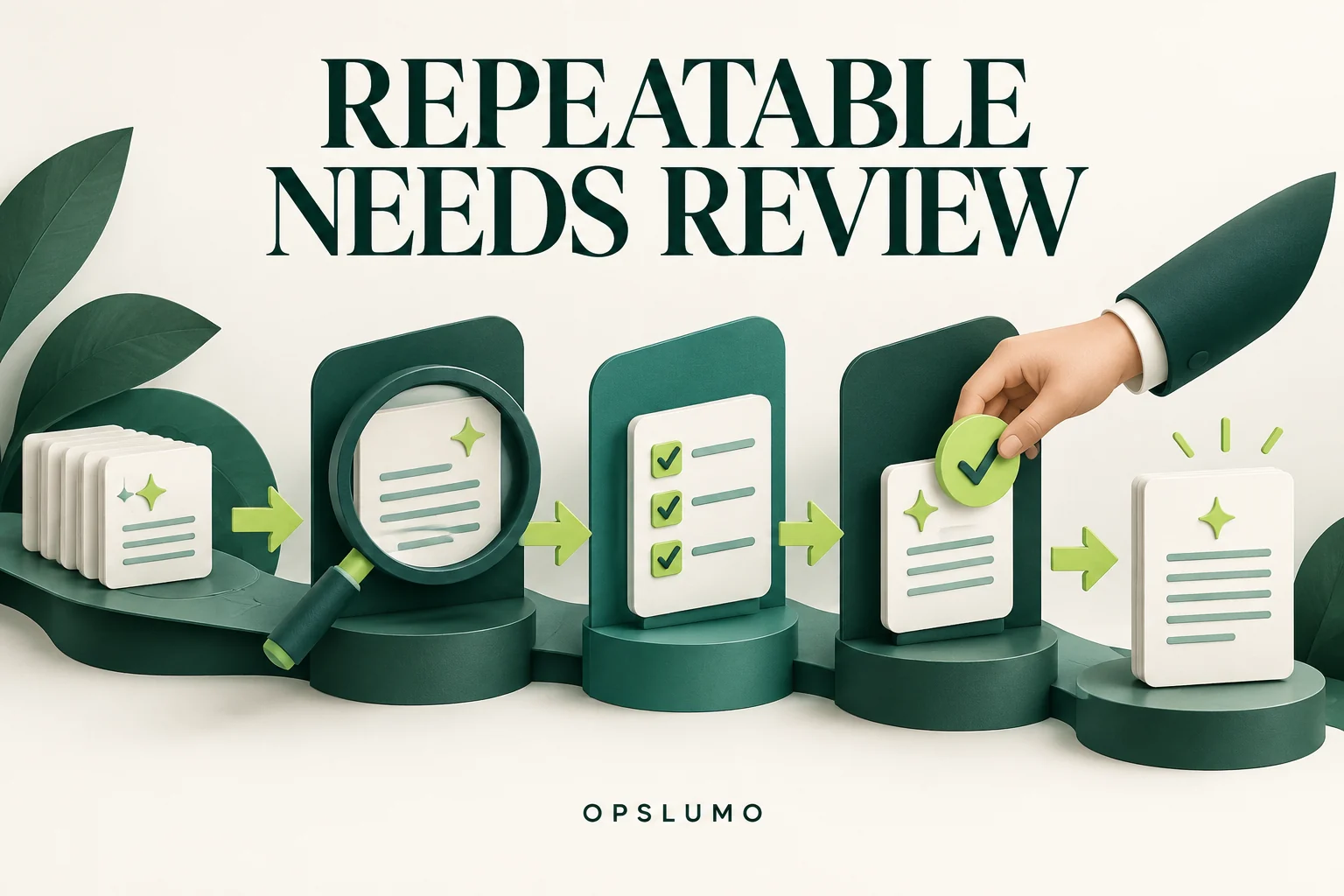
Before a small team reuses a Gemini Skill, it should test the output against a written acceptance rule, include incomplete and conflicting inputs, and keep a person responsible for releasing the result. A saved instruction can make a task easier to repeat. It does not establish that the answer is accurate.
Consider a routine supplier comparison. The first draft looks tidy: three suppliers, prices, lead times, and a recommendation. The trouble appears when one supplier has no current price. Does the workflow leave the field blank, ask for clarification, or quietly invent a number? That is a better test than whether the table looks consistent.
What changed with Gemini Skills?
Google announced Skills in Gemini on September 30, 2026. Its official announcement describes reusable instructions, slash-command invocation, and reference files. Chat rollout is underway; Workspace availability follows separately. Google also lists different Gems transition dates: November 2026 for personal accounts, March 2027 for business, enterprise, and nonprofit accounts, and June 2027 for education. Check your account before planning a cutover; Gems by Google Labs is a separate case.
The useful operational question is what to preserve when moving an existing task: its inputs, its boundaries, and the evidence that a reviewer needs. Copying the prompt alone misses most of that.
Write the acceptance rule before improving the prompt
Start with one low-risk task, such as drafting a weekly internal summary from approved notes. Define its intended reader and the decision it supports. Then write a short rule that a colleague could apply without asking the prompt’s author.
- Every factual statement must trace to a supplied source.
- Missing figures must be marked as missing, not estimated without permission.
- Recommendations must be separated from reported facts.
- The draft must include unresolved questions and the date of its inputs.
- Nothing is sent externally until the named reviewer approves it.
These are proposed operating rules, not a Google certification. A different task may need different rules. A draft meeting agenda, for example, does not need the same evidence standard as a price comparison.
Use a small test pack that includes awkward cases
Build five synthetic or appropriately sanitized examples. The number is a practical starting point, not a validated safety threshold. Keep sensitive customer information out of the test pack unless its use has been approved for that account and tool.
- Ordinary input: complete notes with a clear requested output.
- Missing input: remove a date, price, or owner that the output normally needs.
- Conflicting input: provide two versions of the same fact and require the conflict to be flagged.
- Untrusted instruction: include quoted source text asking the assistant to ignore the task; it should remain source material.
- Out-of-scope request: ask for an action the workflow is not authorized to take, such as sending a client email.
For each case, record the input version, actual output, expected behavior, and reviewer decision. Keep the failed output. A neat final example cannot explain what changed or whether an old mistake has returned.
Compare the old task and the new Skill fairly
Run both versions on the same inputs. Review correctness first, then completeness, then time spent repairing the draft. If the new version takes ten seconds to generate but fifteen minutes to correct, generation speed is a poor measure of its usefulness.
Do not report a productivity percentage from this small exercise. It is a local acceptance check, not a controlled benchmark. If the task varies widely, add examples from the difficult end of the workload before expanding use.
The NIST AI Risk Management Framework is voluntary guidance for managing AI risks. It supports treating evaluation as part of ongoing use; it does not certify a saved prompt or prescribe this five-case test.
Keep a rollback route
Save the previous instructions and reference-file versions before replacing them. Give the updated Skill a clear owner and a review date. Retest after material instruction changes, source-file changes, or observed changes in output behavior. A rollback means returning to a known workflow or manual review, not assuming the previous model response will be reproduced exactly.
For connected workflows, separate drafting permission from permission to send, delete, or modify records. Our guide to prompt injection and action controls explains why checking the final action matters even when the draft seems reasonable.
What should a small team do this week?
Choose one repetitive internal task. Write its acceptance rule, create the five test inputs, and ask someone other than the author to review the results. Keep the workflow in draft-only mode until its known failure cases are handled. Expand only when review work actually becomes easier.
Source and scope note: Product details were checked against Google’s September 30 announcement on October 2, 2026. Rollout and account eligibility can change. The checklist is Opslumo’s proposed practice, not a claim of measured performance.