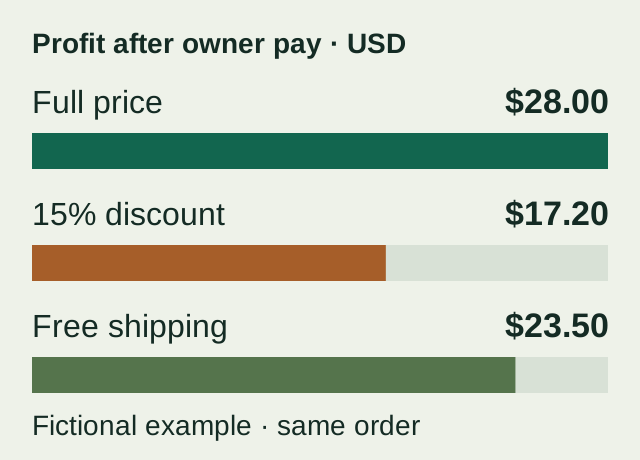
A customer asks for 15% off a handmade order. You could offer free shipping instead. Before choosing, compare what each offer leaves after materials, postage, fees and your own time.
The useful question is: how much does each offer reduce profit on this order? Whether either offer persuades someone to buy requires a separate test. A cheaper offer can leave you worse off even when it produces a sale.
1. Start with the same order
Hold quantity, materials, work time and actual postage constant. Write down what the buyer pays for the items and shipping separately. “Free shipping” removes the buyer’s shipping charge; you still pay the carrier.
Count your time at a chosen hourly rate. Money left before paying yourself can look healthy while providing little business profit after your labor.
Check the fee basis too. Etsy’s selling-fees guide says its 6.5% transaction fee applies to the order amount, including shipping and gift wrapping you charge for. Its separate payment-processing guide says processing rates depend on the bank-account country and apply to shipping and applicable sales tax as well. These are distinct charges.
2. Work through a fictional example
The following USD example uses an assumed 10% fee plus $0.50 per order. Those figures are teaching inputs, not Etsy defaults or a complete Etsy fee calculation. Buyer tax is excluded.
The order contains two items at $40 each. The buyer normally pays $5 shipping. Each item uses $8 of materials and takes 30 minutes to make. The maker’s target pay is $20 per hour. Packaging costs $2 per order, actual postage costs $7, and allocated overhead is $3.
Materials total $16 and owner pay totals $20. Including packaging, postage and overhead, the order’s costs are $48 before selling fees.
| Same two-item order | Full price | 15% item discount | Free shipping |
|---|---|---|---|
| Item revenue | $80.00 | $68.00 | $80.00 |
| Buyer shipping charge | $5.00 | $5.00 | $0.00 |
| Revenue, excluding buyer tax | $85.00 | $73.00 | $80.00 |
| Assumed selling fees | $9.00 | $7.80 | $8.50 |
| Remaining before owner pay | $48.00 | $37.20 | $43.50 |
| Profit after $20 owner pay | $28.00 | $17.20 | $23.50 |
Full price
- Item revenue
- $80.00
- Buyer shipping charge
- $5.00
- Revenue, excluding buyer tax
- $85.00
- Assumed selling fees
- $9.00
- Remaining before owner pay
- $48.00
- Profit after $20 owner pay
- $28.00
15% item discount
- Item revenue
- $68.00
- Buyer shipping charge
- $5.00
- Revenue, excluding buyer tax
- $73.00
- Assumed selling fees
- $7.80
- Remaining before owner pay
- $37.20
- Profit after $20 owner pay
- $17.20
Free shipping
- Item revenue
- $80.00
- Buyer shipping charge
- $0.00
- Revenue, excluding buyer tax
- $80.00
- Assumed selling fees
- $8.50
- Remaining before owner pay
- $43.50
- Profit after $20 owner pay
- $23.50
The discounted items bring in $68, so revenue is $73 with shipping. Fees are $73 × 10% + $0.50 = $7.80. Subtract $48 of costs to get $17.20 profit.
Free shipping keeps item revenue at $80 but removes the $5 charge. Profit becomes $80 − $8.50 − $48 = $23.50.
3. Compare the concession with your profit floor
In this example, the discount reduces profit by $10.80. Free shipping reduces it by $4.50. Both include the same hour of work and the same postage cost.
The offers also give the buyer different savings: $12 from the item discount versus $5 from free shipping. This comparison shows their costs; it does not establish that the buyer values them equally.
Choose the minimum profit you need after paying yourself before negotiating. If your floor were $20, free shipping would meet it here and the 15% discount would fall short. That $20 floor is another illustration; set yours from your business needs.
If neither offer works, compare a smaller concession, simpler customization or a different delivery arrangement. Raising the price is an option to test. It does not ensure that anyone will buy.
4. Check the result against completed orders
Repeat the comparison with a plausible higher postage cost, especially when destinations vary. Include packing and customer-message time in your measured work time if they are part of fulfilling the order.
The simplified model holds demand, quantity and costs constant. It does not predict conversion, repeat purchases or production-capacity changes. Returns, ad attribution, currency conversion, tax treatment and platform-specific fee caps may require separate calculations.
For Etsy orders, check current official fees and your payment-account entries. A single blended percentage cannot reproduce every fee basis. After fulfillment, compare the estimate with the actual postage, time and charges.
Run your own comparison
Use the free Handmade Order Offer Comparator to compare full price, a discount and free shipping for one order. Enter your own assumptions and read both the amount before owner pay and the profit after it.
For repeated product comparisons and historical order records, the optional Handmade Order Pricing Toolkit is a $19 one-time Excel purchase. The free comparison stands on its own.
Official fee sources checked October 28, 2026. The example and calculations above are original illustrations, separate from Etsy’s published policies.