AI automation is often presented to small businesses as a technology purchase: choose a model, connect a few applications, and wait for productivity to improve. In practice, the difficult part is not gaining access to AI. It is identifying a business process that is stable enough to automate, important enough to justify the effort, and controlled enough to improve without introducing new operational risk.
The most successful first projects are rarely ambitious. They remove friction from a process the company already performs every day. A customer inquiry arrives, an employee reads it, extracts the relevant details, decides what is missing, records the opportunity, and drafts a response. None of these actions is individually difficult. The cost appears when the same sequence is repeated across dozens of messages, interrupted by other work, and handled differently by each person.
Automation begins with process clarity
The process must be understood before it can be improved
Before introducing AI, a business needs to understand how work actually moves—not how the process is described in a policy document. The practical workflow often contains invisible decisions: which inquiries deserve an immediate response, what information is required before quoting, who is allowed to approve an exception, and when a stalled request should be escalated. If those decisions remain implicit, automation merely executes an unclear process faster.
A useful discovery exercise follows several real cases from beginning to end. This reveals where information is copied, where people wait for answers, where ownership becomes uncertain, and where judgment is genuinely required. The goal is not to eliminate every manual step. It is to separate routine coordination from decisions that benefit from experience, context, or accountability.
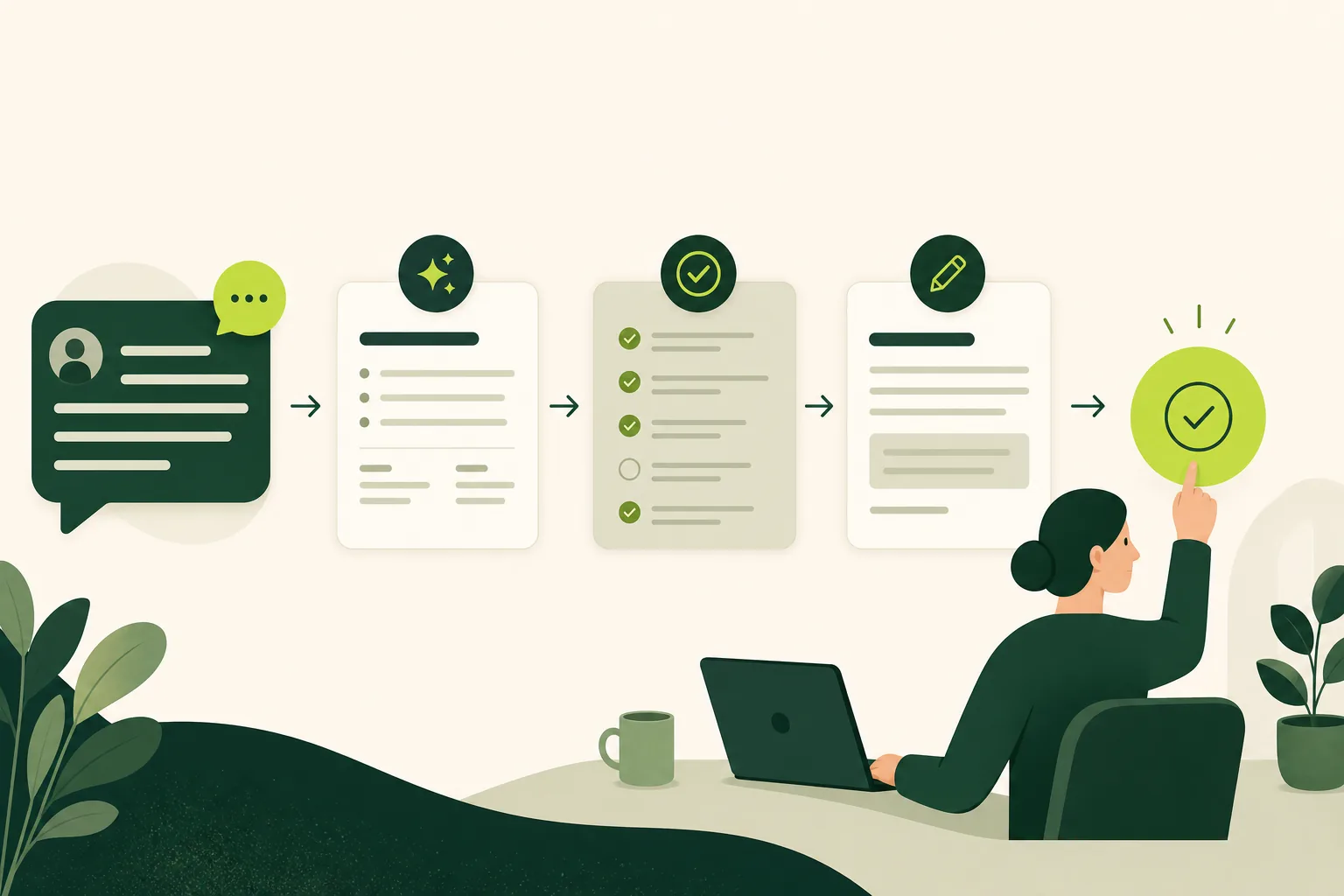
A sound first workflow preserves human authority: an inquiry is converted into a structured summary, missing information is highlighted, a response is drafted, and a person approves the final action.
Use AI only where language creates friction
Traditional automation is reliable when the rules are explicit. It is well suited to moving a record, assigning an owner, calculating a deadline, updating a status, or sending a notification. AI is valuable where the input is less predictable: interpreting a free-form email, recognizing the service being requested, summarizing a conversation, or adapting a draft to the customer’s situation.
Combining the two approaches produces a more dependable system than asking AI to control the entire process. The AI layer interprets and drafts; the workflow layer enforces ownership, timing, permissions, and audit history. This distinction matters because language models are probabilistic. They can produce an excellent summary and still misunderstand an unusual case. A deterministic workflow can ensure that the unusual case is flagged rather than silently processed.
The first project should have a narrow boundary
A workflow is a good candidate when its inputs and outputs can be described, examples occur frequently, and a reviewer can recognize a correct result. Inquiry triage, invoice extraction, meeting summaries, recurring reports, and follow-up preparation often meet these conditions. Broad ideas such as an “AI employee” do not. They combine too many responsibilities, make failures difficult to diagnose, and create expectations that cannot be measured.
Scope also determines the quality of the result. A system designed around one clearly defined inquiry process can use the company’s qualification criteria, preferred tone, service boundaries, and escalation rules. A generic assistant has none of that operational context. Professional automation therefore looks less like a chatbot and more like a carefully designed service process with AI embedded at specific points.
Measure operational change, not AI activity
Counting generated summaries or automated actions says little about business value. The relevant question is whether the workflow changes an outcome the company cares about. For an inquiry process, that may be median response time, the number of leads without an owner, the percentage of requests missing qualification data, or the amount of staff time required to prepare a first reply.
A baseline should be established before implementation and compared with a controlled trial. The trial should include normal cases, incomplete requests, ambiguous messages, and situations that require escalation. This exposes not only whether the system works, but where it should refuse to act. A workflow that handles eighty percent of routine cases consistently and sends the remaining twenty percent to a person can be more valuable than one that attempts full autonomy.
Governance is part of the design
Small businesses may not use the language of AI governance, but they still need its practical protections. Customer data should be limited to what the workflow requires. Access should follow existing responsibilities. Drafts, approvals, and changes should be recorded. Sensitive promises, pricing decisions, financial actions, and unusual customer situations should remain subject to human review.
These controls do not make automation slow. They make it usable. Employees are more likely to trust a system when they understand what it does, when it asks for help, and who remains responsible for the final decision. Customers benefit because speed improves without replacing judgment with an opaque automated response.
A practical path to implementation
The right sequence is to document the current process, examine a representative set of real examples, define the smallest valuable output, and run the workflow alongside the existing method. Failures and exceptions should be recorded as design information rather than hidden. Only after the system performs consistently should it be connected to more channels or given permission to take additional actions.
This disciplined approach may appear less exciting than a large AI transformation, but it produces something more valuable: a workflow the business can understand, measure, and improve. For a small team, one reliable automation that protects response quality and returns several hours each week is a stronger foundation than a collection of impressive demos that never become part of daily operations.