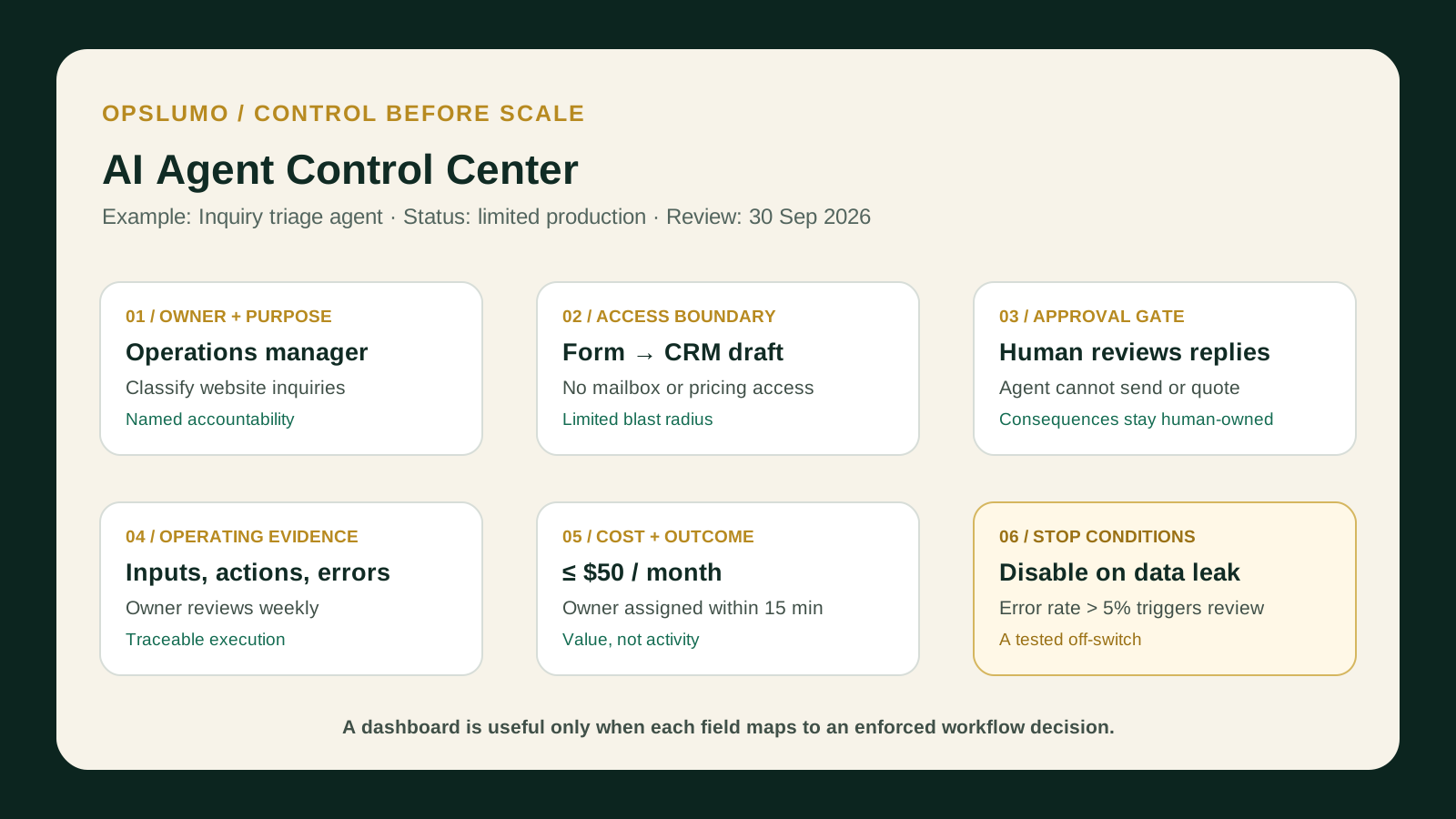
An AI agent control center is a management layer—not necessarily a new software product. For every production agent, track six decisions: owner and purpose; access boundary; human approval gate; operating evidence; cost and business outcome; and stop conditions with the next review date. If one field is unknown, the agent is not ready for broader authority.
Why “one command center” became a current topic
On September 8, 2026, Deutsche Telekom announced AI-agent platforms that emphasise a central view of costs, responsibilities and access to business systems. This is a vendor announcement, not independent proof that one platform is necessary. It is still a useful market signal: organisations are moving from isolated agent experiments toward operational control.
The practical question for a small business is not “Which command center should we buy?” It is “Which decisions must remain visible before an agent can act?” One or two agents can be governed in a structured spreadsheet, database or existing operations dashboard. Software should follow the control model.
Conclusion: track six fields before production
| Control field | Minimum record | Decision it supports |
|---|---|---|
| 1. Owner + purpose | Named business owner, task, users and success condition | Who answers when scope or results change? |
| 2. Access boundary | Identity, credentials, data, tools, network and environments | What is the maximum plausible impact? |
| 3. Approval gate | Actions requiring before-the-fact approval and named approver | Which consequences remain human-owned? |
| 4. Operating evidence | Inputs, outputs, tool calls, denials, errors and alerts | Can the team reconstruct what happened? |
| 5. Cost + outcome | Budget cap plus one business result | Is the agent creating value or only activity? |
| 6. Stop + review | Disable method, trigger thresholds, owner and review date | Can the team contain harm and reconsider authority? |
NIST’s AI RMF Playbook supports maintaining an inventory with ownership and system information. The NCSC’s interim agentic-AI guidance adds the operational layer: match oversight to autonomy, constrain the environment, log and monitor activity, make actions attributable and retain an emergency shutdown path.
Control field 1: give the agent a business owner, not just a developer
The owner defines the job, acceptable exceptions and success measure. “Customer-service agent” is too broad. “Classify website inquiries, create a CRM draft and notify the operations manager” is reviewable. The owner should be able to narrow the task, pause it and explain why the agent exists.
Control field 2: make access narrower than the human operator’s access
A person’s credentials are often wider than one automated task requires. NIST recently highlighted a common risk: people giving personal or enterprise credentials directly to agents. Give an agent its own identity where the system supports it, limit credentials to the shortest useful lifetime and restrict tools, data and network destinations.
Document read, write, send, publish, delete and payment authority separately. “CRM access” hides the decision that matters: can the agent read one form queue, update every customer record, export the database or send external messages?
Control field 3: place approval before the consequence
Human review is not meaningful if it happens only after a price was quoted, a record deleted or a message sent. Define the gate in the workflow. Low-impact classification may run automatically; commitments, external communication, payment, deletion and sensitive-data decisions may require approval before execution.
The NCSC distinguishes human-in-the-loop, human-on-the-loop and autonomous operation. Choose intentionally. More autonomy increases the need for technical limits, monitoring and a tested response path.
Control field 4: log decisions someone will actually review
CISA describes logging as recording who accessed what, when and from where, and recommends alerts for high-risk events. For an agent workflow, record the agent identity, trigger, input reference, tools called, action attempted, policy decision, approver, outcome and error. Avoid copying unnecessary sensitive content into the log.
A log without an owner or review cadence is storage, not control. Assign a weekly review during the pilot and define which event creates an immediate alert.
Control field 5: pair cost with one operational result
Token use, task count and response volume are operating measures. They do not prove value. Pair a monthly cost cap with an outcome such as time to assign an inquiry, percentage of complete intake records, manual corrections per 100 runs or hours of verified repetitive work removed.
Set a comparison baseline before launch. If the process becomes faster but correction work rises, the control center should make that trade-off visible.
Control field 6: define how the agent stops
Record the actual disable action, who can perform it and what triggers it. Examples include unexpected access, an unapproved external action, sensitive data in the wrong system, error rate above a defined threshold, cost above budget or a vendor change that invalidates the review.
Test the off-switch before production. A written shutdown instruction is not enough if the responsible person lacks access or the credentials continue to work.
Illustrative case: inquiry triage without automated promises
This example is fictional. A twelve-person service business receives website inquiries in a shared inbox. Its agent reads approved form fields, classifies the requested service, creates a CRM draft and alerts the operations manager. It cannot access the full mailbox, send replies, quote prices or change an existing customer record.
The owner measures the percentage of new inquiries assigned within 15 minutes and the number of classifications corrected by a human. A $50 monthly cost cap and 5% correction threshold trigger review. Every proposed reply requires approval. The operations manager can disable the integration and revoke the agent credential from one documented location.
This is not “fully autonomous sales.” It is a bounded handoff with visible value and consequences that remain human-owned.
Start small: three operating levels
- Draft-only assistant: reads approved input and proposes an output; a person executes every consequential action.
- Approval-gated agent: can prepare system actions but a named person approves selected steps before execution.
- Bounded autonomous agent: acts within an enforced low-impact scope, with monitoring, thresholds and tested shutdown.
Progress only when evidence supports the next level. A small team does not earn operational maturity by granting more autonomy.
Frequently asked questions
Do we need to buy an AI agent governance platform?
Not necessarily. A small number of agents can begin with a controlled register and existing monitoring tools. A specialised platform may become useful when agents, integrations, policies and reviewers multiply.
Is a dashboard an enforcement control?
No. It is a visibility layer unless the underlying identity, permission, approval and shutdown controls are technically enforced.
What should be measured first?
Choose one operational result the agent is expected to improve, one correction or exception measure, and one cost boundary. Record the baseline before launch.
The operating rule: scale the number of agents only after ownership, access, approval, evidence, value and shutdown are visible for the agent already in production.
Where Opslumo fits
Opslumo helps small teams map the workflow, define approval gates, connect systems and build bounded automation around a measurable outcome. We do not replace cybersecurity, legal or compliance specialists. For the access lifecycle, see AI agent security starts with onboarding.
Sources and methodology
The September 8 Telekom announcement is treated as a vendor market signal, not outcome evidence. Control recommendations are grounded in current NCSC, NIST and CISA guidance. The example dashboard and case are original, fictional illustrations.